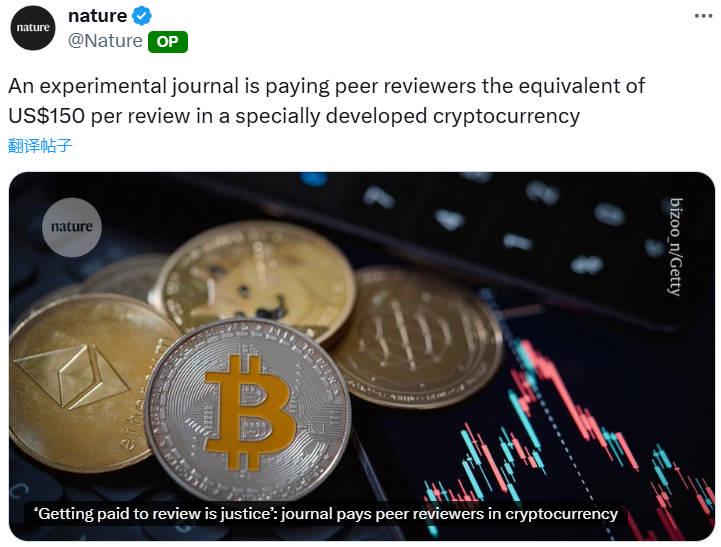
Is the academic circle also "playing with coins"? The DeSci project ResearchHub became popular after being reported by the top journal "Nature".

CN
PANews
Follow
1 year ago

Original author: Brayden Lindrea, Cointelegraph

Translation: Yuliya, PANews

One of the world's most influential scientific journals, Nature, recently focused on an innovative project that is changing the academic review model. This decentralized science (DeSci) protocol called ResearchHub is reshaping the traditional academic peer review system through cryptocurrency incentive mechanisms.

Innovative Review Incentive Mechanism

As a top journal with a monthly visit count of 9 million, Nature highlighted the innovative model of the ResearchHub platform in an article on December 11. The platform offers peer reviewers cryptocurrency worth $150 for independently reviewing new research papers. This model has already shown positive results in practice, with the article specifically mentioning the case of Pedro Paulo Gattai Gomes, a molecular biology advisor in São Paulo. He stated, "The income I earn from reviewing on ResearchHub has already surpassed my income as a professor at an academic institution."

This scientist reviews an average of 15 papers per month, earning ResearchCoin tokens (RSC) worth $150 for each review. He told the journal, "Receiving payment for reviews is fair because pure volunteer work often doesn't even get a thank you, which I find very unreasonable." Considering that Nature has an impact factor of 50.5, this coverage undoubtedly provides significant exposure for DeSci.

Is the academic world also "playing with coins"? The DeSci project ResearchHub gained popularity after being reported by the top journal *Nature*

Market Performance and Industry Support

This innovative model has also received a positive response from the market. According to CoinGecko data, RSC rose nearly 20% within 24 hours, reaching $1.01, with a market capitalization of $96.1 million. The DeSci protocol ResearchHub, established in 2020, has received strong support from Coinbase CEO Brian Armstrong. Armstrong emphasized at the ResearchHub Journal launch event held in San Francisco last month: "It is a strange phenomenon in history that peer reviewers are not compensated; the work they do is valuable and should be recognized and rewarded."

Challenges and Countermeasures

However, Nature also pointed out some challenges faced by the platform. Although ResearchHub addresses some issues in the scientific community, its "radical nature" may make it difficult to scale.

On a practical level, Nature noted that many scientists may encounter difficulties when converting RSC into fiat currency. They need to exchange RSC for mainstream cryptocurrencies like BTC, ETH, or USDC through decentralized exchanges like Uniswap before transferring it to centralized exchanges to convert it into fiat and withdraw.

Nevertheless, ResearchHub has taken steps to simplify this process. On November 29, RSC was officially listed on the centralized exchange Gate.io, providing users with a more convenient trading channel.

Is the academic world also "playing with coins"? The DeSci project ResearchHub gained popularity after being reported by the top journal *Nature*

Platform Operation and Future Development

Although ResearchHub was officially launched last month, it has been operating a decentralized academic review mechanism since May 2023, incentivizing reviewers to review, comment on, and vote on preprints through tokens. The platform adopts a Web3 native model, allowing users to tip each other for quality content using RSC tokens or initiate bounty tasks, such as generating data analysis for comments.

In terms of economic model design, authors are required to pay a $1,000 article processing fee, and the platform charges a 7% protocol fee on all RSC token transactions, of which 2% is automatically allocated back to the community ecosystem through smart contracts.

Nature pointed out that as a decentralized academic journal, ResearchHub has not yet published its first paper and is not indexed by traditional bibliometric databases like Web of Science or Scopus. However, it is noteworthy that the DeSci (decentralized science) sector is entering a period of explosive growth, having reached a five-year high on Google Trends in November.

The Broad Prospects of DeSci

The significance of DeSci goes far beyond this; it is actively addressing fundamental challenges faced by the traditional scientific field, such as funding shortages, data sharing, and collaboration. Its application scope has expanded to specific areas such as advancing research, reducing the cost of genetic testing, and treating hair loss. According to CoinGecko data, the total market capitalization of leading DeSci tokens has surpassed $1.2 billion, highlighting the immense growth potential and market recognition of this field.

免责声明:本文章仅代表作者个人观点,不代表本平台的立场和观点。本文章仅供信息分享,不构成对任何人的任何投资建议。用户与作者之间的任何争议,与本平台无关。如网页中刊载的文章或图片涉及侵权,请提供相关的权利证明和身份证明发送邮件到support@aicoin.com,本平台相关工作人员将会进行核查。

Share To
APP

X

Telegram

Facebook

Reddit

CopyLink