Author: YettaS
USDT, with its extensive circulation and large asset scale globally, has become the most important liquidity tool in the offshore market. However, our questions about Tether have never ceased: Why is Tether considered the de facto central bank of our industry? Why is the U.S. regulatory attitude towards it so ambivalent—neither fully suppressing it nor providing clear support? What does its existence mean for the U.S. financial market? In this tug-of-war, where is its breaking point? This article will help you think about the significance of stablecoins from a more macro perspective, which is a prerequisite for breakthroughs in this field.
How is Tether a Good Business?
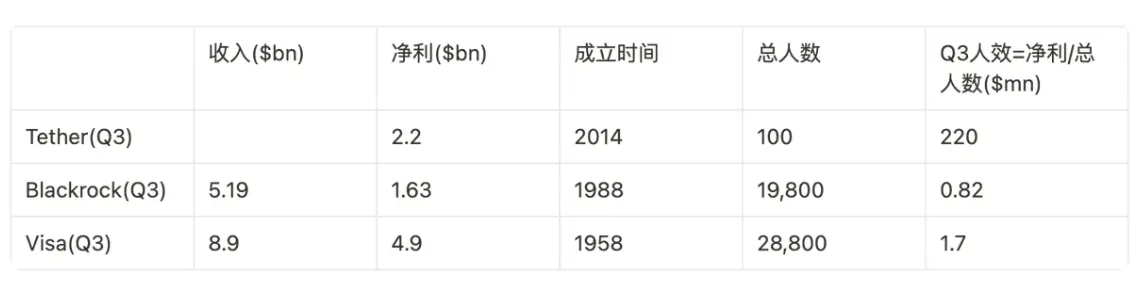
Tether's latest Q3 data showcases its strong profitability. As of Q3, its total assets reached $125 billion, with approximately $102 billion in U.S. Treasury bonds, a net profit of $2 billion for Q3, and a cumulative profit of $7.7 billion for the year. In comparison, BlackRock's Q3 profit was $1.6 billion, and Visa's was $4.9 billion, while Tether's workforce is less than one percent of theirs, achieving over a hundred times their productivity.

source: primitive ventures
Source: Primitive Ventures
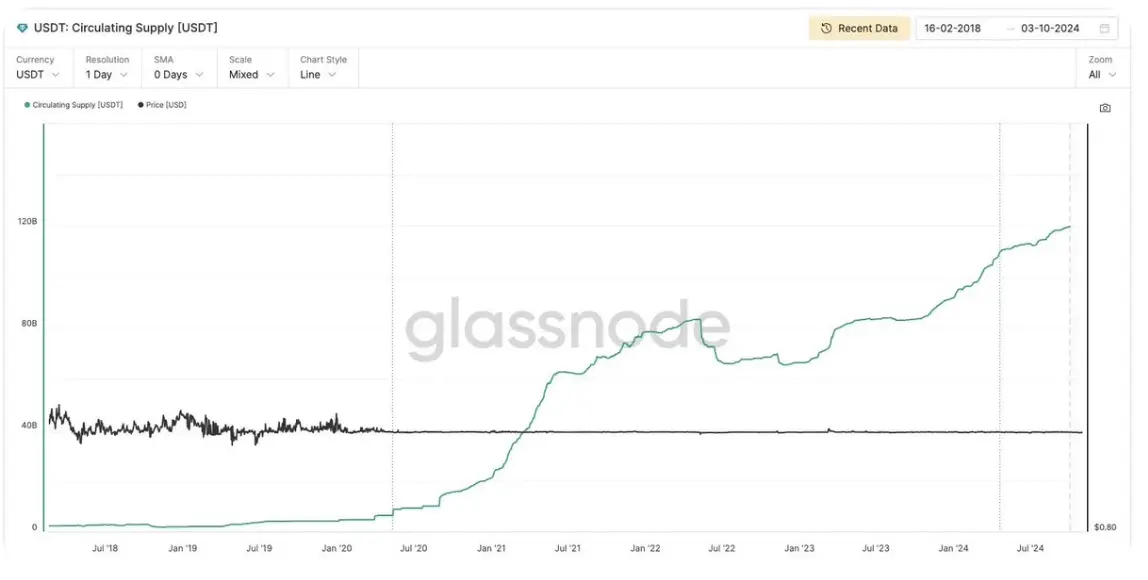
In fact, Tether did not have a spectacular start; it began with a small demand. At that time, all exchanges had BTC trading pairs, with prices fluctuating on both sides, making settlement inconvenient. Bitfinex identified this issue and launched USDT as a unit of account (UoA), which was its first use case. In 2019, Sun discovered the cross-chain demand for stablecoins between exchanges; ETH transfers to USDT were expensive and slow, while on Tron, they were cheap and fast. Sun immediately began subsidizing and capturing the market on a large scale, spending hundreds of millions (of course, from Tron node profits) to subsidize TRC20-USDT exchange deposits and withdrawals, allowing users to enjoy returns of 16%-30% at that time. As a medium of exchange (MoE) for inter-exchange transfers, this was its second use case. The subsequent story is well-known; USDT was widely adopted in the off-chain world as a store of value (SoV) in countries with hyperinflation and as a medium of exchange (MoE) in various gray areas, becoming the shadow dollar, which is its third use case. Through these three evolutions, Tether has grown alongside the market capitalization and liquidity of USDT.
For detailed guidance on how to create a successful stablecoin, Dovey's article provides comprehensive insights, which you are welcome to learn from.

source: Glassnode
Source: Glassnode
Currently, over 80% of Tether's assets are invested in U.S. Treasury bonds, giving Tether characteristics similar to a government money market fund, with high asset safety and ample liquidity. As a SoV, its safety surpasses that of deposits, which carry risks from the bank's asset side; the impact of SVB's bankruptcy on USDC is an example, while Treasury bonds are the lowest-risk financial products.
Moreover, it also outperforms money market funds because money market funds do not have a currency settlement function; they are merely products for sale and cannot serve as currency in circulation. This is also why Tether has such high productivity; USDT, as an MoE, significantly reduces friction in currency circulation compared to existing cross-border settlement or payment channels. As the nominal shadow dollar and the most widely accepted UoA, various channels and exchange platforms have become Tether's workers, helping it expand its network globally.
This is the allure of the currency business. Tether combines payment, settlement, and treasury management, effectively becoming the Federal Reserve of our industry—something unimaginable before the advent of crypto. Its network effect expands with liquidity, which cannot be disrupted simply by distributing a 5% yield to users and employing token vampire attacks.
With this in mind, we can understand why PayPal is launching a stablecoin; as its business expands, it has already achieved capital accumulation and payment settlement, and stablecoins are the best vehicle for all of this. From another perspective, will U.S. banks and money market funds not envy this business?
From Too Big to Fail to Too Deep to Fail
It would actually be quite simple for the U.S. to eliminate Tether, as the custody of U.S. Treasury bonds is highly centralized. Since Tether was investigated by the Department of Justice in 2021 and transferred to the Southern District of New York's prominent prosecutor, Darmian William, at the end of 2022 (who handles almost all high-profile crypto crime cases, including the SBF case), it is not that they cannot do it, but that they do not want to. So, what is the reason for this reluctance?
First, there is the liquidity risk in the U.S. Treasury market. With 80% of Tether's assets in U.S. Treasury bonds, if regulators impose extreme restrictions that force Tether to sell off a large amount of Treasury bonds, it could lead to turmoil or even a collapse in the Treasury market. This is the "too big to fail" aspect.
More importantly, there is the global expansion of USDT as a shadow dollar. In regions with severe global inflation, USDT is seen as a means of value storage; in areas under financial sanctions and capital controls, USDT becomes the currency for underground transactions; it can be found in places associated with terrorism, drugs, fraud, and money laundering. As USDT is used in more countries, through more channels and in more scenarios, its anti-fragility will significantly increase. This is the "too deep to fail" aspect.
The Federal Reserve would certainly welcome this, as its dual mission is to maintain price stability and achieve full employment, but at a deeper level, it is about strengthening dollar hegemony and controlling global capital flows. It is precisely the widespread circulation of USDT and USDC that helps the dollar expand its offshore liquidity. USDC is a regulated on/off-ramp tool for dollars, while USDT, through its extensive channels, permeates the globe. The underground banking system and gray remittance services of USDT effectively facilitate the circulation of dollars and cross-border payments. This helps the U.S. maintain its dominant role in the global financial order, further deepening dollar hegemony.
Where Does the Resistance to Tether Come From?
Although Tether has helped sustain U.S. financial hegemony in various ways, its game with U.S. regulators still exists. Hayes once said, "Tether could be shut down by the U.S. banking system overnight, even if it is operating completely in accordance with the law."
First, it cannot support the Federal Reserve's monetary policy. As a fully reserved stablecoin, Tether does not adjust liquidity in line with the Federal Reserve's monetary policy, and it cannot participate in the Federal Reserve's quantitative easing or tightening like commercial banks. While this independence enhances its credibility, it also makes it difficult for the Federal Reserve to achieve its monetary policy goals through Tether.
Second, the Treasury must be wary of the potential turmoil it could cause in the Treasury market. If Tether were to collapse due to unforeseen events, it would have to sell off a large amount of Treasury bonds, putting immense pressure on the Treasury market. This was widely discussed at the Treasury's borrowing advisory committee meeting on October 29, where the possibility of tokenizing Treasury bonds to mitigate USDT's impact on the Treasury market was considered.
Finally, and most importantly, Tether effectively squeezes the survival space of banks and money market funds. The high liquidity and high yields of stablecoins attract an increasing number of users, posing a significant challenge to banks' deposit-raising capabilities and the appeal of money market funds. Meanwhile, Tether's business is highly profitable, so why can't banks and money market funds do the same? The introduction of the Lummis-Gillibrand Payment Stablecoin Act in April this year, which encourages more banks and trust institutions to participate in the stablecoin market, is a testament to this.
Tether's development is, in fact, a grand narrative of struggle, where regulatory arbitrage, burdened with original sin, has provided it with immense opportunities and space for growth. Now, it finally has the leverage to begin to contend with old powers. Where it can go is uncertain, but any groundbreaking innovation is a redistribution of past power and interest structures.
The Possibility of a Supranational Currency System
To transcend the dollar system, Tether's future lies not only in maintaining its role in global payments and liquidity but also in thinking more deeply about how to construct a truly supranational currency system. I believe the key lies in its linkage to BTC. In 2023, Tether took the lead in this step by allocating 15% of its profits to Bitcoin, which is not only an attempt at asset reserve diversification but also effectively makes BTC an important component supporting its stablecoin ecosystem.
In the future, as Tether's payment network expands and BTC deepens its role as a supranational currency in the global market, we may witness a brand new financial order.
A revolution often begins at the margins, germinating in the cracks of the old era's beliefs. The reverence for Rome has turned the dominance of Roman civilization into a "self-fulfilling prophecy."
The process of the birth of a new deity may be random, but the twilight of the old gods is already destined.
免责声明:本文章仅代表作者个人观点,不代表本平台的立场和观点。本文章仅供信息分享,不构成对任何人的任何投资建议。用户与作者之间的任何争议,与本平台无关。如网页中刊载的文章或图片涉及侵权,请提供相关的权利证明和身份证明发送邮件到support@aicoin.com,本平台相关工作人员将会进行核查。