DAWN: Closed-loop Network System
DAWN is a decentralized wireless network protocol. Its business logic involves nodes purchasing DAWN hardware antennas to build a wireless network offline and provide opportunities for users to trade network bandwidth with each other. The entire system forms a closed-loop network system through validation by validators and the Solana network.
Funding: Strong Support from Dragonfly
DAWN has made significant progress in terms of funding. The project has completed two rounds of financing, with a total amount of $33 million.
On August 7, 2024, a financing amount of $18 million was completed, led by Dragonfly, with participation from CMT Digital, Castle Island Ventures, Wintermute Ventures, 6th Man Ventures, and ParaFi.
Additionally, in the A-round financing on February 28 last year, a financing amount of $15 million was completed, also led by Dragonfly, with other participating institutions including Castle Island and Blockchange Ventures.
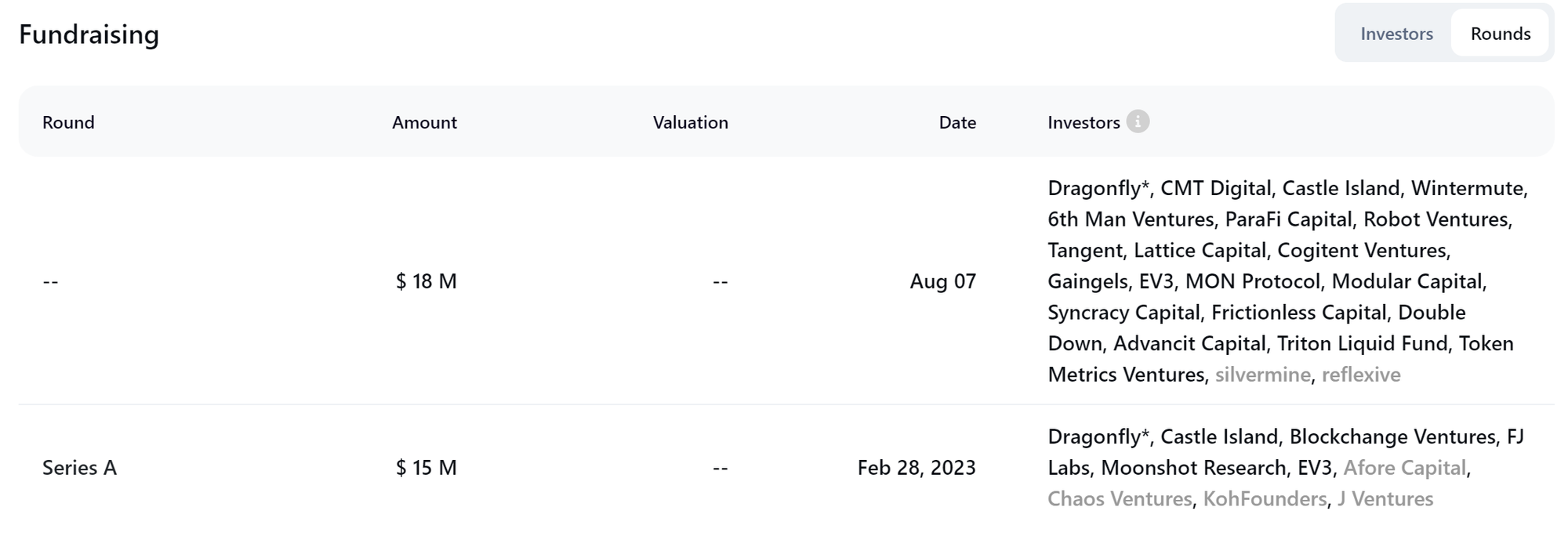
DAWN Investment and Financing Records Source: 10xWolfDAO Compilation
Key Team Members

Neil Chatterjee served as Vice President of Engineering at Dentboard from January 2014 to December 2016. Since 2016, he has been the CEO of Andrena. Neil studied electrical engineering at Princeton University, New Jersey Institute of Technology, and Montclair State University.

James Smits is the co-founder and COO of Andrena. James has also served as a venture capital partner at KohFounders and Beta Bridge Capital. Previously, he worked as a business development assistant at Banyan Water and a mentor at the University of Melbourne Accelerator Program. James studied economics and environmental studies at Princeton University.
Quick Participation in DAWN
First, add the DAWN extension application in Google Extensions, open the application, and then log in or register for a DAWN account.
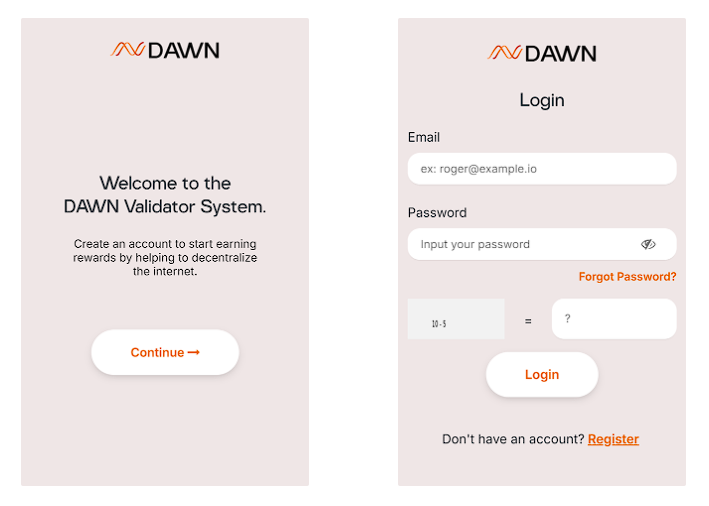 DAWN Participation Guide: Log in or Register for a DAWN Account Source: 10xWolfDAO Compilation
After logging in, you can automatically connect to the DAWN network to start earning points. You can check the current connection status, connection quality, and scores. You can also earn more points by following X, joining Discord, and TG.
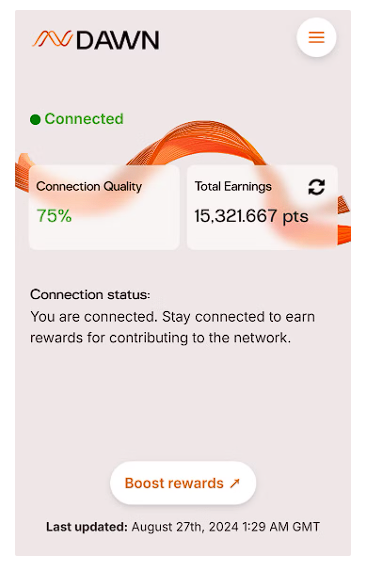
DAWN Participation Guide: Node Rewards Source: 10xWolfDAO Compilation
Validator nodes will be launched in the near future, so stay tuned.
DAWN Project Mechanism
DAWN is a decentralized network protocol designed to guide and orchestrate user-driven multi-gigabit mesh networks, providing users with fast, convenient, and affordable wireless internet. Its vision includes:
- Transforming internet bandwidth into a commodity, breaking enterprise monopolies, and allowing anyone to participate in usage and trading.
- Shifting from several large data centers to thousands of small data centers (homes), redistributing and transferring the wealth of cloud infrastructure to households.
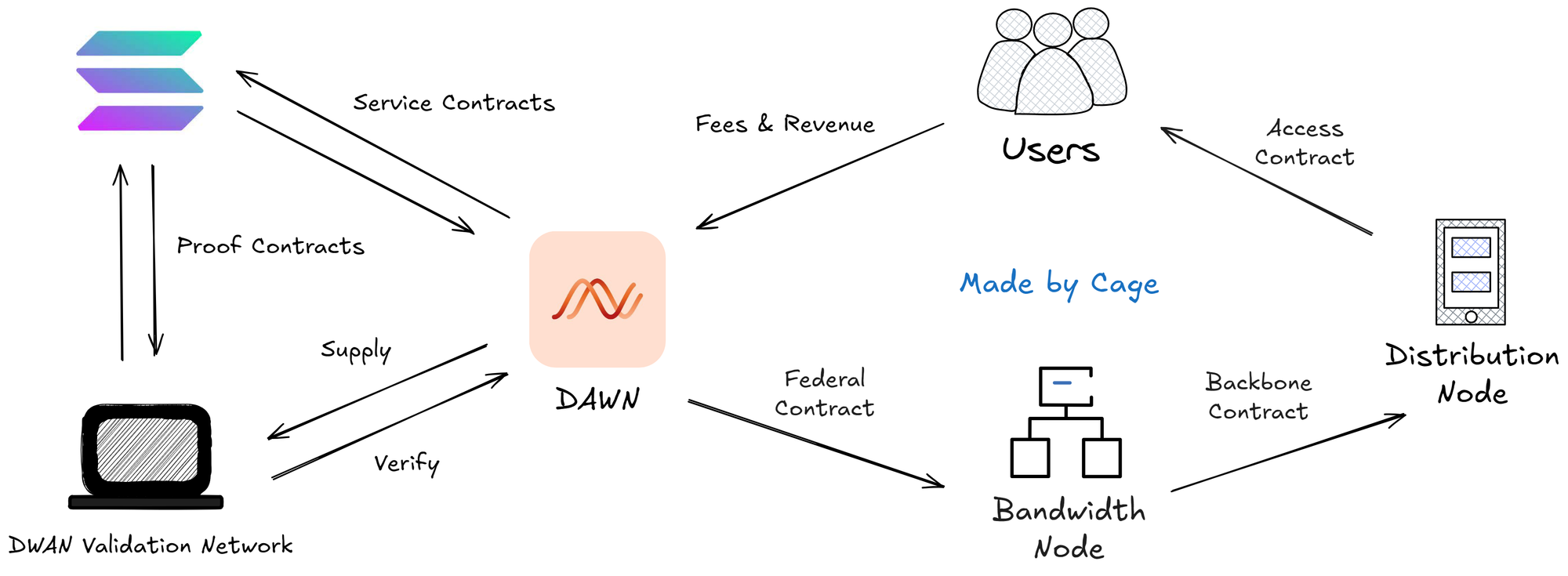
DAWN Project Operation Mechanism (Made by Cage) Source: 10xWolfDAO Compilation
In the DAWN network, there are multiple participants:
- Bandwidth Node (BN): Provides resalable internet capacity and wholesale IP transmission.
- Distribution Node (DN): Deployed in commercial or residential areas, the DWAN robot antenna system.
- End User (EU): Users who use wireless bandwidth through DWAN.
- DAWN Foundation: Responsible for multi-sign control of smart contracts, standardizing interactions between all nodes, aggregating and auditing all information, and settlement.
- Validation Network (VN): Independent validators outside the DAWN network system, responsible for verifying the authenticity and validity of internal network transmissions of DAWN.
- Solana: Responsible for receiving and providing feedback on Proof and Service contracts from VN and the protocol.
Core Protocol - Tradable Network Bandwidth
In the traditional world, internet bandwidth has always been managed and allocated by large internet service providers (ISPs), and consumers have no say in its allocation and pricing. DAWN attempts to use point-to-multipoint (P2MP) wireless technology to enable the network services provided by nodes to communicate efficiently among various nodes, equivalent to fiber optics.
DAWN allows users to purchase their own internet bandwidth and sell the remaining bandwidth back to the public network. Through the bandwidth allocation system formed by numerous users within the network, centralized ISPs are split into several small ISPs, with each user/node playing its role, thereby providing a more decentralized internet service.
Hardware
The DAWN hardware consists of RAS and CNHR, aiming to enhance network coverage and stability, simplify user experience, and lay the foundation for future cloud applications.
BN and DN will use a combination of point-to-multipoint wireless radio antennas, and DAWN refers to this hardware-software combination system as the Robot-Antenna System (RAS).
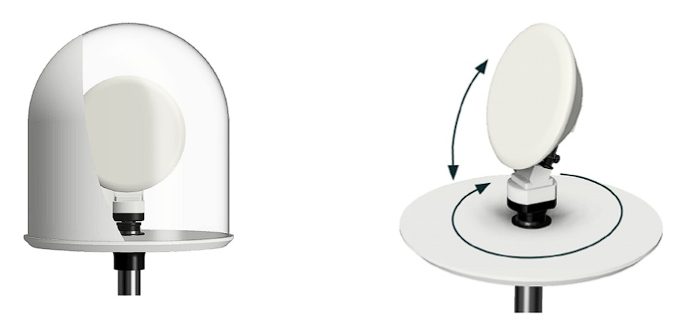
- RAS can automatically perform wireless configuration and radio adjustments without the need for users to have any technical expertise for deployment, making it more accessible.
- Dynamic antennas allow the network to continuously adjust positioning to find the best data transmission path.
On the terminal, users use the x86 architecture Cloud Native Home Router (CNHR) provided by the team to access the DWAN network. The router uses two breakthrough technologies:
- DPDK (Data Plane Development Kit): Enhances network performance by allowing processors to directly access the Network Interface Card (NIC), facilitating efficient packet processing for user-space applications, managed by the Linux Foundation.
- VPP (Vector Packet Processing): Significantly improves router performance by leveraging centralized batch processing and packet handling using DPDK, developed by Cisco.
In addition, CNHR also attempts to achieve seamless gigabit network sharing among neighbors through Frequency-Division Duplexing.
Infrastructure Costs
There are two important metrics to measure the cost of building any telecommunications network:
- Cost to pass a home: The cost of network coverage passing through end users, measured in cost per home/dollar. Reflects the cost of laying fiber optic cables along the street and deploying supplier signal towers.
- Cost to activate a home: The actual cost of linking and activating network services.
Although the activation cost of decentralized fixed wireless networks (approximately $1000) is more expensive than fiber ($200-400), the cost per home is much lower (fixed wireless $10-15, fiber $750-1100).
Higher coverage creation efficiency makes DAWN feasible, enabling widespread and cost-effective wireless coverage. Despite the higher activation cost, it includes advantages such as ownership, passive income potential, and access to cheaper bandwidth, making it still viable.
Bandwidth and Economic Effects
Bandwidth costs are divided into two aspects: Wholesale IP Transit and Internet Exchanges, crucial for achieving cost-effective internet access.
- Wholesale IP Transit: Services where ISPs, Content Delivery Networks (CDNs), and large enterprises purchase bulk internet connections from tier 1 networks capable of globally routing data. These wholesale providers have extensive network infrastructure connecting multiple regions and continents, ensuring efficient and high-speed data flow on the internet.
- Internet Exchanges (IX) are critical physical infrastructure in the internet ecosystem, where different networks (e.g., ISPs, CDNs, and large enterprises) converge to directly exchange traffic between their networks. This direct exchange is known as peering.
The unit bandwidth price of DAWN will be cheaper under the combination of these two traffic sources. In the case of small-scale residential gigabit network services, the cost will be as low as $0.45, and the cost for dedicated gigabit connections will be $40.
Therefore, the DWAN solution provides a highly cost-effective coverage method. For users, accessing bandwidth under the DAWN network coverage will be very cheap, with the main cost being the initial activation fee for homes.
Consensus Mechanism
DAWN uses three consensus mechanisms to maintain the network's robustness and transparency:
- Proof of Backhaul: Measures the throughput of each node, aiming to verify the transparency of service delivery.
For example, if a node claims to provide 1Gbps but fails to do so, only providing 400Mbps, PoB will be used to adjust payments and delivery mechanisms based on automatic/smart contract Service Level Agreement (SLA) and compensate users for lower performance. This ensures that users receive the service they paid for, providers receive the appropriate compensation, and completely eliminates the need for trust.
- Proof of Location: Ensures accurate reporting of the physical location of each node.
The accuracy of geographical location is crucial for asset and resource network deployment planning. PoL links network rewards to verifiable locations of other trusted nodes, making nodes responsible for accurately reporting their declared locations.
- Proof of Frequency: Confirms the use of wireless spectrum by each node.
Effective management is crucial to prevent pollution and interference due to the limited nature of wireless spectrum. When nodes use any frequency they want, the background noise of the wireless channel increases, providing poorer wireless performance.
PoF ensures that each node automatically uses the appropriate channel, especially important for the 60GHz and 6GHz frequency bands used by DAWN, maintaining high-quality network performance while avoiding congestion issues common in traditional 2.4GHz and 5GHz WiFi networks.
Token Economics
Token Allocation
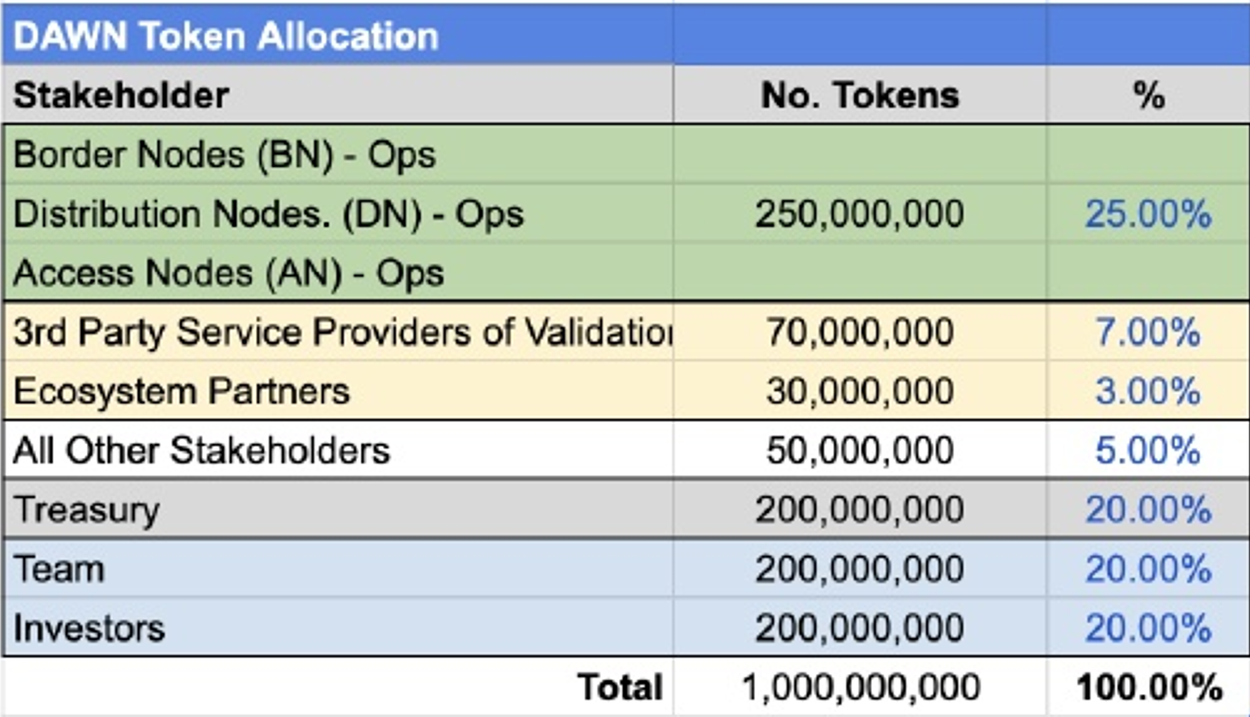
DAWN Token Economics Allocation Scheme
Token Utility
- Incentivizing stakeholders in the internet (BN, DN, EU, etc.).
- Serving as the currency for trading network bandwidth in front-end applications (to be launched in the future).
Reward Rules
- Bandwidth seeding: Rewards for BNs providing bandwidth to EUs.
- Initial activation: Users activating RAS will receive a certain amount of tokens monthly, calculated as a percentage of various costs.
- Geolocation: Users in strategically important areas will receive a certain proportion of rewards, calculated as a multiple of the initial activation reward for nodes.
- Performance verification: Rewards for all parties providing data and verification.
- DNs: Rewards for DNs providing services to EUs, calculated based on the cumulative value of transactions/connections provided to users.
Medallion System
The Medallion system is a crucial part of the DAWN economic model, aimed at ensuring long-term network coverage.
It is a mechanism where any token holder can incentivize the development of a high-potential area within the network. By prepaying DAWN tokens, they can receive a certain percentage of future income from that area.
- Users need to stake 100,000 DAWN tokens to obtain a medallion. The price curve of the medallion increases linearly, meaning that after the initial stage, the price of each subsequent medallion within the same area will gradually exceed the previous one.
- Medallion holders can activate some rewards in the medallion area by allocating the medallion to specific mechanisms and can increase the reward multiplier to attract node operators to deploy in that area.
- To prevent excessive inflation, DAWN implements a profit burning mechanism:
- Medallion profit ≤50%, no burning
- Medallion profit = 50 - 100%, 10% burning
- Medallion profit >100%, 30% burning
- If 100,000 pre-paid tokens are not fully allocated due to insufficient node and network activity, the remaining tokens will not circulate and will be burned.
Conclusion
DAWN is a decentralized wireless network that provides all users with the opportunity to buy and sell network bandwidth, aiming to decentralize deployment and return bargaining power to users from ISPs.
Due to its favor from multiple investors including Dragonfly, and the potential Ponzi flywheel effect in its internal economic model, combined with the expectation of more applications landing in the DePIN track in the future, the DAWN protocol is worth participating in and paying attention to.
免责声明:本文章仅代表作者个人观点,不代表本平台的立场和观点。本文章仅供信息分享,不构成对任何人的任何投资建议。用户与作者之间的任何争议,与本平台无关。如网页中刊载的文章或图片涉及侵权,请提供相关的权利证明和身份证明发送邮件到support@aicoin.com,本平台相关工作人员将会进行核查。


