Author: Fourteen Jun
Introduction
Recently, the Bitcoin L2 project Bitlayer Labs completed a $11 million Series A financing, led by Franklin Templeton, ABCDE, and Framework Ventures. At the same time, Bitlayer became the first Bitcoin infrastructure project to receive investment from an ETF-licensed institution.
Bitlayer is an L2 project for BTC, with the original intention of improving the scalability of BTC and unlocking its ecosystem potential. In terms of project features, Bitlayer is the first L2 based on BitVM, and also the first to fully inherit the security and Turing completeness of BTC.
1. Current Status of BTC L2
The essence of BTC L2 is a cross-chain bridge. Currently, L2 project parties have their own characteristics in cross-chain bridge solutions, but from a technical perspective, the essence of most cross-chain bridge solutions is multi-signature.
In fact, multi-signature solutions have serious trust issues, and incidents of funds being stolen due to multi-signature are not uncommon.
The author believes that L2, as a supplement to L1, should not be limited to the expansion of the ecosystem, but should also inherit the security of L1.
As the first L2 based on BitVM, Bitlayer has achieved minimal trust, and has achieved a good balance between security and scalability. Next, let's follow Fourteen Jun's technical perspective to explore how Bitlayer extends BTC as an L2 while also considering security.
2. Bitlayer - An L2 Balancing Security and Scalability
2.1 Basic Architecture of Bitlayer
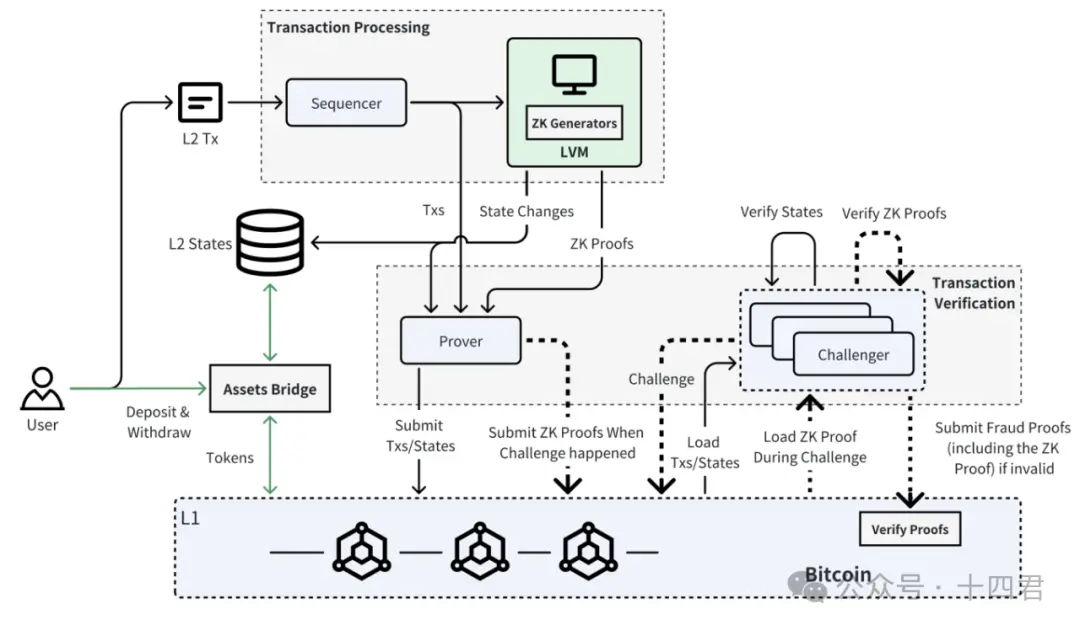
The basic architecture of Bitlayer is shown in the following figure.

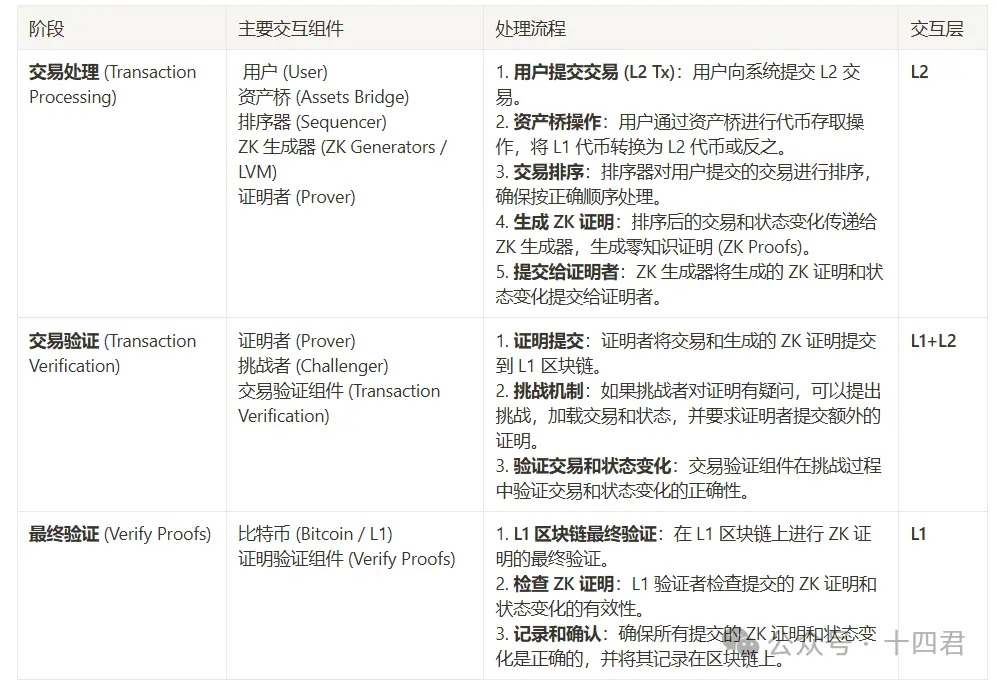
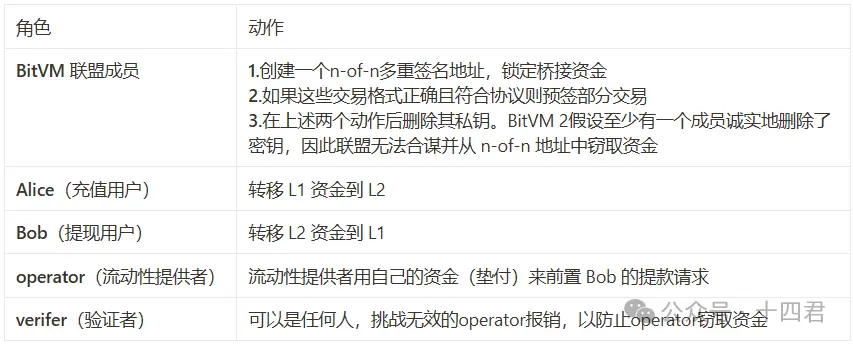
It can be seen that the business process of Bitlayer can be mainly divided into three stages, namely the transaction processing stage, the transaction verification stage, and the final verification stage. The components interacting in each stage and their approximate processing flow are shown in the table below:

Let's break down the core process of Bitlayer together.
2.2 Transaction Processing Stage - Layered Virtual Machine (LVM)
In the transaction processing stage of L2, there are two components: the sequencer and the LVM (Layered Virtual Machine).
Without going into too much detail about the sequencer, the sequencer in Bitlayer is responsible for collecting and sorting cached transactions, serving as the entry point for transactions in Bitlayer.
The LVM is the computing component of Bitlayer, responsible for executing smart contracts and generating the latest state and zero-knowledge proofs.
What is a Layered Virtual Machine?
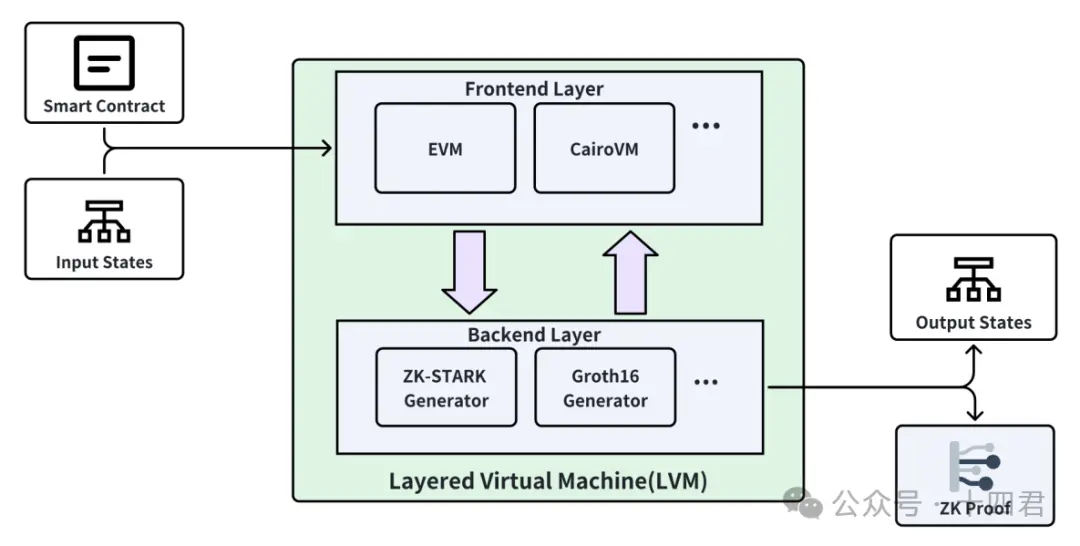
To answer this question, let's look at the following diagram.

Unlike the conventional VM, Bitlayer's LVM decouples the execution of front-end smart contracts from the back-end zero-knowledge proof generator. The VM and zero-knowledge proof generator exist as components in the LVM. This innovation allows Bitlayer to expand support for various contract types and zero-knowledge proof verifiers, significantly improving the system's scalability and security.
2.3 Transaction Verification Stage - OP Bridge Based on ZKP
In the verification stage of transactions, it is actually the interaction stage between L1 and L2. When assets flow between L1 and L2 in the form of transactions, we face the classic L2 cross-chain problem: How does L2 inherit the security of L1?
Classic L2 Cross-Chain Problem: How does L2 inherit the security of L1?
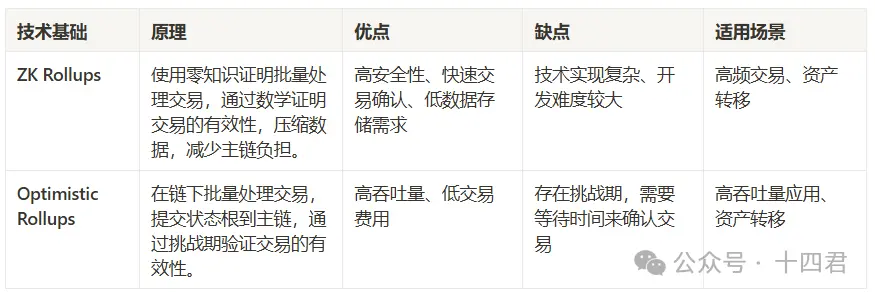
In fact, there are already very mature solutions on ETH. Currently, the mainstream and secure solutions are mainly ZK bridges and OP bridges. A comparison of the two is shown in the table below:

The ZK bridge itself is currently the most secure cross-chain bridge solution because it does not require trust. The OP bridge uses fraud proofs to challenge invalid cross-chain data (a 1-N security model) to ensure the security of cross-chain data. It seems that the ZK bridge is more secure than the OP bridge, but in reality, Bitlayer's core dependency, BitVM, chooses the OP bridge.
Why the OP bridge?
The main reason is still technical limitations. Currently, only the deposit direction from BTC L1 to L2 is supported by ZK bridges, and for withdrawals from L2 to BTC L1, only multi-signature bridges or OP bridges are supported. For security reasons, Bitlayer chose the more secure OP bridge, which is actually a compromise.
Bitlayer's cross-chain bridge solution is in the form of a combination of BitVM bridge and OP-DLC bridge. The OP-DLC bridge is a supplement to the BitVM bridge.
Analysis of the BitVM && OP-DLC Dual Combination Bridge Process
Bitlayer uses the BitVM bridge to ensure security, while supplementing it with OP-DLC to reduce dependence on BitVM. Up to now, the BitVM bridge has undergone several upgrades and achieved a leap from pure theory to practicality.
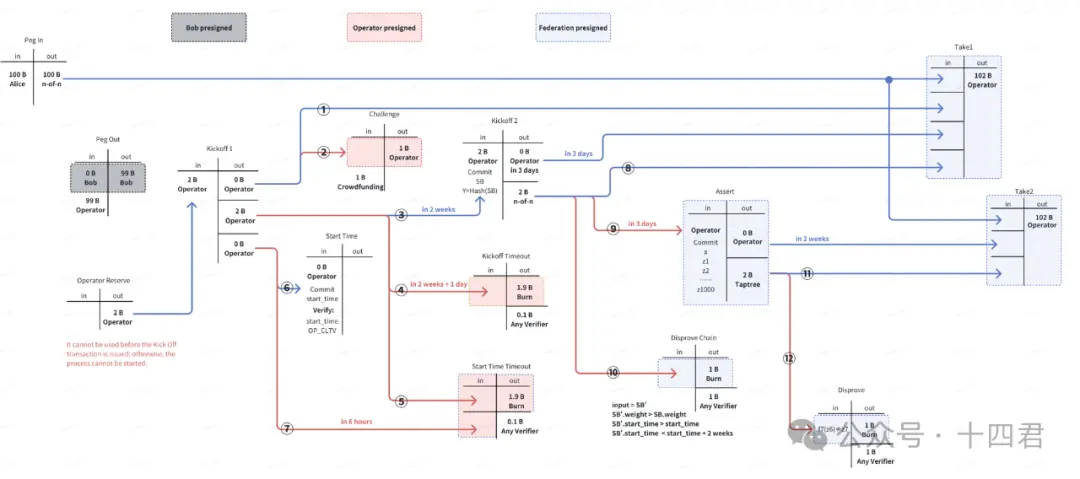
The latest process diagram of the BitVM bridge is as follows:

In the entire process, there are a total of 5 roles.

How to understand this model?
From a model perspective, the BitVM bridge is based on a pre-funding and reimbursement model. The operator node pre-funds the funds for the withdrawal user and regularly applies for reimbursement to the public deposit address, earning fees from the difference (from the withdrawal user's fees).
If the operator behaves fraudulently and falsely reports transaction data, anyone can challenge it and impose penalties.
Is security guaranteed?
We all know that when transferring cross-chain funds, it relies on a public fund pool (essentially assets locked by users), and the security of the fund pool is the core issue that all cross-chain bridges need to address.
Traditional BTC L2 solutions generally manage the public fund pool through multi-signature, which obviously carries trust risks. The BitVM bridge, on the other hand, adopts a similar approach to the Lightning Network, designating who can take the pre-specified funds. When users lock funds into the public fund pool, they communicate with the alliance, locking the funds in a Taproot address, which can only be claimed by the operator. The operator can only unlock the related funds after providing proof of the pre-funding to the chain and being challenged without error.
It can be said that the BitVM bridge achieves the decentralization of the fund pool by introducing the operator, which is indeed innovative. Based on past experience, we tend to think about how to achieve decentralized fund management methods, but we overlook the fact that the concept of the fund pool itself is centralized. The BitVM bridge decentralizes the fund pool, fundamentally improving the security of the chain bridge.
So, what are the shortcomings?
However, no solution is perfect, and there are always some unsatisfactory aspects.
Careful readers will notice that the BitVM bridge, where the operator pre-funds the user and then reimburses from the public account, is similar to a fund pool. One pool is the public account (the assets locked by users, responsible for direct reimbursement to the operator), and the other pool is formed by the operator, used to directly fund user withdrawal requests (this pool is virtual, dispersed among different operators).
When users initiate withdrawals, they directly interact with the operator, effectively making the operator's final funds become part of the fund pool.
The funds of withdrawing users, after passing through the operator as a third party, no longer come from the fund pool, and at the same time, are mixed with other users' funds.
Due to this fund pool model, BitVM bridge actually cannot meet the independence requirements for funds for some users who are very concerned about the source of funds.
To address this issue and reduce over-reliance on the BitVM bridge, Bitlayer has added the OP-DLC bridge solution, similar to a pipeline concept, to enable P2P transactions for users. The security of the OP-DLC bridge relies on fraud proofs and third-party oracles.
What about usability?
The security of the BitVM bridge is beyond doubt, but usability issues need continuous development. For example, according to BitVM's expectations, a large number of alliance members need to be online and correctly pre-sign to ensure the correct process, which is actually a challenge.
3. Conclusion
In terms of architecture, Bitlayer's LVM decouples the execution of smart contracts from zero-knowledge proofs, which is a forward-thinking design concept, making it possible for Bitlayer to adapt to various VMs and zero-knowledge proof verifiers in the future.
In the technical selection of cross-chain bridges, Bitlayer's dual-channel bridge of BitVM + OP-DLC is basically the most secure cross-chain bridge implementation for BTC L2 at present (achieving minimal trust).
Through the integration of technology and engineering, based on BitVM, Bitlayer has built a relatively balanced cross-chain bridge solution that considers both security and scalability. However, this is only a transitional phase, a compromise after weighing security and scalability.
Minimizing trust should be the goal pursued by BTC L2. As BitVM becomes more practical bit by bit, and from what I understand, there is expected to be a major breakthrough in Bitlayer's BitVM construction in about three months, I look forward to Bitlayer gradually becoming the BTC L2 we are expecting.
免责声明:本文章仅代表作者个人观点,不代表本平台的立场和观点。本文章仅供信息分享,不构成对任何人的任何投资建议。用户与作者之间的任何争议,与本平台无关。如网页中刊载的文章或图片涉及侵权,请提供相关的权利证明和身份证明发送邮件到support@aicoin.com,本平台相关工作人员将会进行核查。