Where is the best place for a Web3 startup to establish its company with lower taxes?

CN
1 year ago

With the vigorous development of global Web3.0 technology, an increasing number of Chinese entrepreneurs are choosing to start businesses overseas, especially in the policy-friendly and stable environments of Hong Kong and Singapore. Hong Kong and Singapore have shown a positive attitude and transparent regulation in the field of Web3.0, providing great convenience and support for entrepreneurs. In Hong Kong, well-known Web3.0 companies such as Animoca Brands and HashKey have achieved significant success globally through continuous innovation and expansion. Singapore has attracted industry giants like Binance and Crypto.com, becoming a hotbed for blockchain and cryptocurrency entrepreneurship due to its favorable legal framework and tax incentives.

When entrepreneurs choose a location for their business, they need to consider not only the policy environment but also the tax planning perspective to select the most favorable region for the long-term development of their enterprises.

Comparison of Policies in Three Regions

The tax policies in mainland China, Hong Kong, and Singapore differ in specific ways, as outlined below.

Mainland China vs. Hong Kong

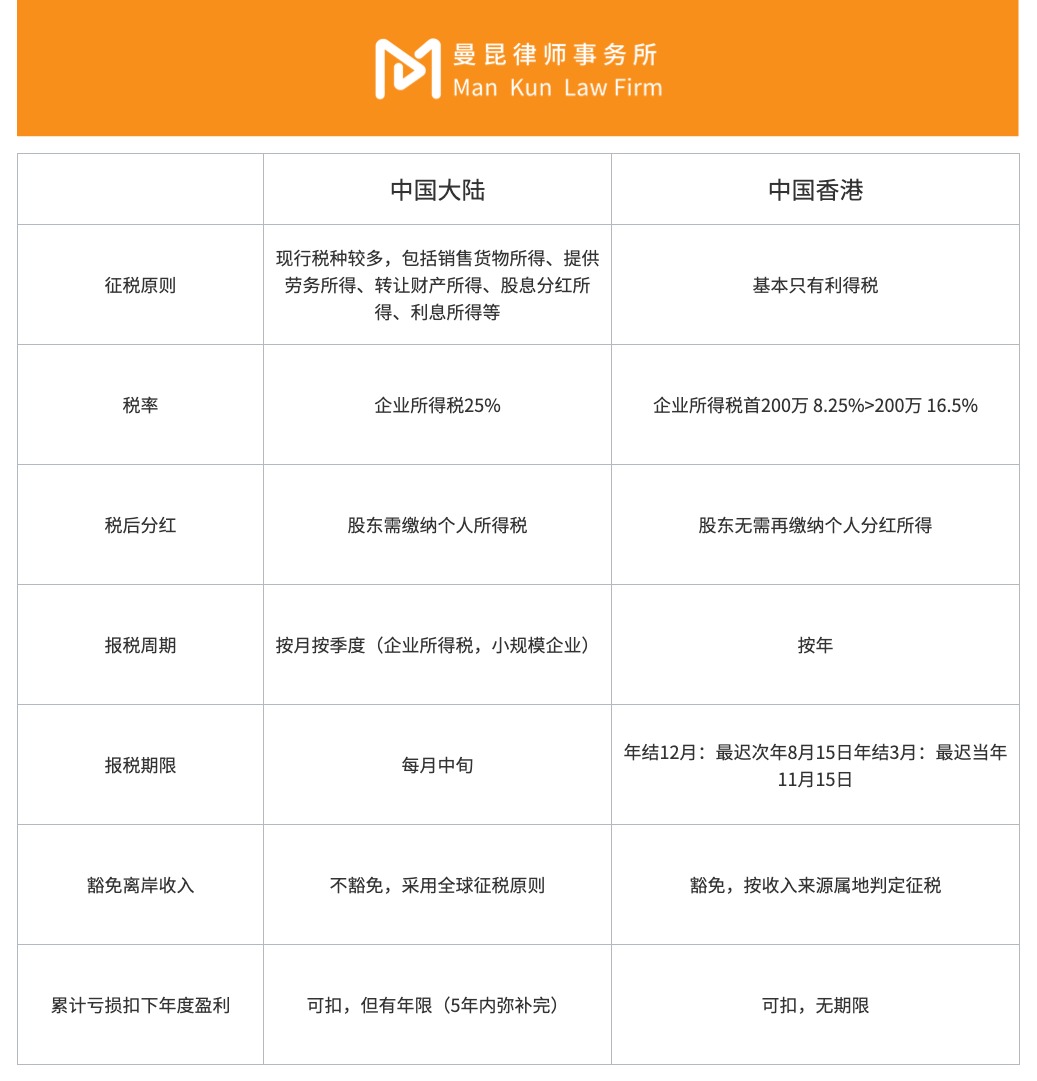
In terms of tax system, the main differences for enterprises between mainland China and Hong Kong are as follows:

Web3 Entrepreneurship, Where is the Lower Tax for Companies?

In terms of major tax types, mainland China has a total of 6 major items, specifically:

  • Corporate income tax (5%, 15%, 25%)
  • Personal income tax (3%-45%)
  • Value-added tax (3%, 9%, 13%, etc.)
  • Shareholder dividends, capital gains, etc. (20%)
  • Overseas income (global taxation)

The main tax types in Hong Kong include corporate profits tax (8.25%-16.5%) and salaries tax (2%-17%), with no tax required for shareholder dividends, overseas income, and stock appreciation.

China vs. Singapore

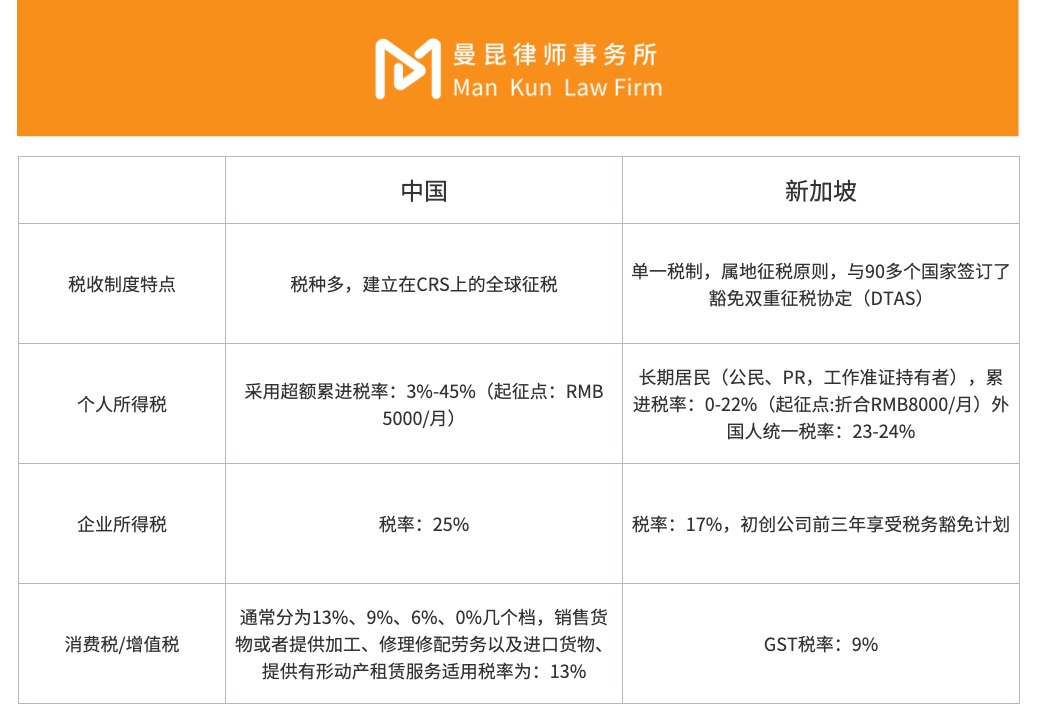
In terms of tax system, there are significant differences between China and Singapore, as shown below:

Web3 Entrepreneurship, Where is the Lower Tax for Companies?

Next, through three specific cases, we will illustrate the tax responsibilities and costs faced by entrepreneurs when starting companies in mainland China, Hong Kong, and Singapore.

Case One: Entrepreneurship in Mainland China

Mr. Wang is a young Web3 entrepreneur who has established a blockchain technology company in Beijing, focusing on developing decentralized applications (dApps).

Company-level Taxation

Assuming Mr. Wang's company achieves annual operating revenue of 10 million RMB in its first year, with pre-tax profit of 5 million RMB. According to China's tax policies, his company needs to pay 25% corporate income tax, which amounts to 1.25 million RMB. In addition, his company also needs to pay value-added tax. Assuming his products are subject to a 13% tax rate and have 5 million RMB in input tax, the value-added tax he needs to pay is (10-5) * 13% = 0.65 million RMB.

Personal-level Taxation

As the sole shareholder of the company, Mr. Wang receives dividends of 3.75 million RMB (after deducting 1.25 million RMB corporate income tax from the 5 million RMB pre-tax profit), which requires him to pay 0.75 million RMB in dividend tax. Assuming he receives an annual pre-tax salary of 1 million RMB, based on China's progressive tax rate, his personal income tax is approximately 0.43 million RMB (simplified calculation).

In the end, Mr. Wang's take-home income is: 1 million RMB (salary) + 3.75 million RMB (dividends) - 0.43 million RMB (personal income tax) - 0.75 million RMB (dividend tax) = 3.57 million RMB.

Case Two: Entrepreneurship in Hong Kong

Ms. Li is an experienced Web3 entrepreneur who has established a financial technology company in Hong Kong, primarily providing blockchain solutions for multinational enterprises.

Company-level Taxation

Assuming Ms. Li's company achieves annual operating revenue of 10 million HKD in its first year, with pre-tax profit of 5 million HKD. According to Hong Kong's tax policies, the tax rate for the first 2 million HKD of profit is 8.25%, and the remaining portion is subject to a 16.5% tax rate. She needs to pay 0.66 million HKD in corporate income tax (200 million × 8.25% + 300 million × 16.5%).

Personal-level Taxation

Ms. Li (a tax resident of Hong Kong) receives an annual salary of 1 million HKD from the company. Based on Hong Kong's progressive tax rate, her personal income tax is approximately 0.15 million HKD (simplified calculation). In addition, she receives dividends of 4.34 million HKD (after deducting 0.66 million HKD in corporate income tax from the 5 million HKD pre-tax profit), and no tax is required for dividends in Hong Kong.

In the end, Ms. Li's take-home income is: 1 million HKD (salary) + 4.34 million HKD (dividends) - 0.15 million HKD (personal income tax) = 5.19 million HKD.

Case Three: Entrepreneurship in Singapore

Mr. Chen (a tax resident of Singapore) is a seasoned Web3 entrepreneur who has established a cryptocurrency exchange in Singapore, focusing on providing secure and efficient digital asset trading services.

Company-level Taxation

Assuming Mr. Chen's company achieves annual operating revenue of 10 million SGD in its first year, with pre-tax profit of 5 million SGD. According to Singapore's tax policies, the first 200,000 SGD of profit enjoys tax relief, and the total tax payable is approximately 0.82875 million SGD (1.275 + 4.8 million × 17%).

In addition, his company also needs to pay a 9% goods and services tax (GST). Assuming a portion of the annual sales is subject to GST, the GST he needs to pay is approximately 0.9 million SGD (10 million × 9%).

Personal-level Taxation

As the main shareholder of the company, Mr. Chen receives an annual salary of 1 million SGD. Based on Singapore's progressive tax rate, his personal income tax is approximately 0.24 million SGD (simplified calculation). He also receives dividends of 4.17125 million SGD (after deducting 0.82875 million SGD in corporate income tax from the 5 million SGD pre-tax profit), and no tax is required for dividends in Singapore.

In the end, Mr. Chen's take-home income is: 1 million SGD (salary) + 4.17125 million SGD (dividends) - 0.24 million SGD (personal income tax) = 4.93125 million SGD.

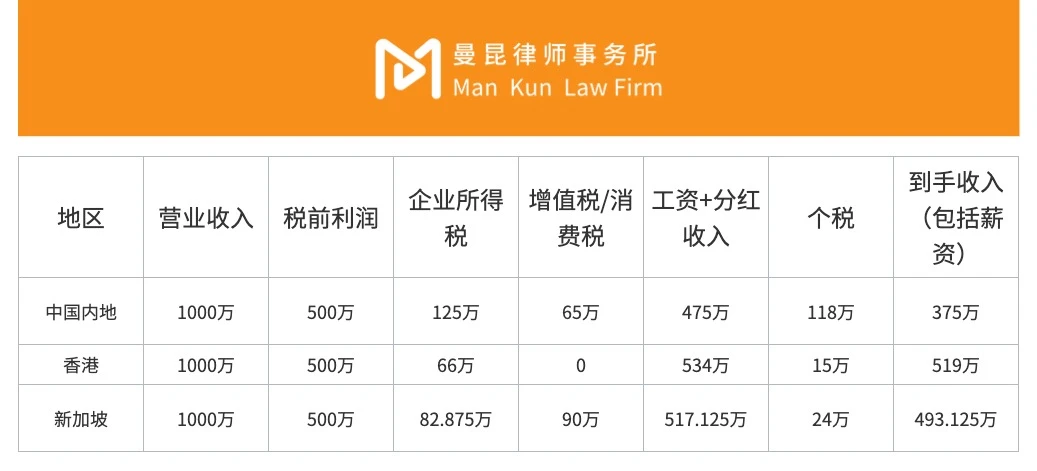
Summary of Data Comparison

Web3 Entrepreneurship, Where is the Lower Tax for Companies?

The above data comparison shows that the tax policies in different regions have a significant impact on entrepreneurs. Hong Kong has the lightest tax burden, with only three direct taxes and tax-free thresholds, resulting in the highest take-home income for entrepreneurs. Singapore follows, with a lower tax burden, but due to the need to pay consumption tax, the final income is slightly lower than that of Hong Kong. Mainland China has a heavier tax burden, resulting in the lowest take-home income. These data can help entrepreneurs make wiser decisions when choosing a location for their businesses.

It should be noted that the tax rates used by the entrepreneurs in different countries or regions need to comply with the relevant regulations for the entrepreneurs as local tax residents. If Chinese tax residents start businesses overseas, income obtained from outside China generally needs to be declared and taxed at the tax authorities in the place where the income is obtained, with the tax declaration period being from March 1st to June 30th of the following year.

Conclusion

For Web3 entrepreneurs, choosing the right location for entrepreneurship not only requires consideration of tax knowledge and tax costs but also involves comparing the regulatory policies and legal environments of different countries to ensure the long-term development of their enterprises. Hong Kong and Singapore's open attitude and superior tax policies in the Web3 field provide a good development platform for entrepreneurs. However, before making decisions, it is recommended that entrepreneurs consult professional lawyers and financial advisors to fully understand the legal regulations and tax risks in different locations and make the most favorable choice.

This article does not constitute legal, accounting, or tax advice. Readers should understand and use this article based on appropriate professional opinions from qualified professionals.

免责声明:本文章仅代表作者个人观点,不代表本平台的立场和观点。本文章仅供信息分享,不构成对任何人的任何投资建议。用户与作者之间的任何争议,与本平台无关。如网页中刊载的文章或图片涉及侵权,请提供相关的权利证明和身份证明发送邮件到support@aicoin.com,本平台相关工作人员将会进行核查。

Share To
APP

X

Telegram

Facebook

Reddit

CopyLink