"Web3 will help us trust artificial intelligence".
Author: Will Ogden Moore
Translation: Luffy, Foresight News
Artificial Intelligence (AI) is one of the most promising emerging technologies of this century, with the potential to greatly increase human productivity and drive breakthroughs in medicine. While AI has already made its mark, its future impact is expected to be even greater. PwC estimates that by 2030, it will develop into a massive industry worth $15 trillion.
However, this promising technology also faces challenges. As AI technology becomes more powerful, the AI industry becomes highly centralized, with power concentrated in the hands of a few companies, posing a potential threat to the entire human society. AI has also raised serious concerns about deepfakes, bias, and data privacy risks. Fortunately, cryptocurrency and its decentralized and transparent nature provide potential solutions to some of these issues.
Below, we will explore the problems caused by centralization and how decentralized AI can help address some of these drawbacks, and discuss the current intersection of cryptocurrency and AI, focusing on the early signs of adoption of cryptocurrency applications in this field.
Problems with Centralized AI
Today, the development of AI faces certain challenges and risks. The network effects and intensive capital requirements of AI are so significant that AI developers outside of large tech companies, such as small companies or academic researchers, either struggle to access the resources needed for development or fail to commercialize their work. This limits the overall competition and innovation in the AI industry.
As a result, the influence of this critical technology is mainly concentrated in a few companies such as OpenAI and Google, raising serious questions about AI governance. For example, in February of this year, Google's AI image generator Gemini exposed racial bias and historical inaccuracies. Additionally, in November of last year, a six-person board decided to dismiss OpenAI CEO Sam Altman, exposing the fact that a few individuals control these companies.
As the influence and importance of AI continue to grow, many are concerned that a single company may wield decision-making power over AI models that have a huge impact on society, potentially setting up barriers, operating behind closed doors, or manipulating models for their own gain.
How Decentralized AI Provides Assistance
Decentralized AI refers to the use of blockchain technology to distribute ownership and governance of AI in a way that enhances transparency and accessibility. Grayscale Research believes that decentralized AI has the potential to liberate these critical decisions from closed institutions and transfer them to the public.
Blockchain technology can help developers have more access to AI, lowering the barriers for independent developers to develop and commercialize AI. We believe this can help improve innovation and competition in the AI industry, achieving a certain balance between small companies and tech giants.
Furthermore, decentralized AI helps democratize AI investment. Currently, apart from a few tech stocks, there are almost no other ways to gain financial returns related to AI development. Meanwhile, a large amount of private capital is allocated to AI startups and private companies (470 billion USD in 2022 and 420 billion USD in 2023). As a result, only a small number of venture capitalists and accredited investors can gain financial returns from these companies. In contrast, decentralized AI crypto assets are equal for everyone, allowing everyone to own a part of the future of AI.
Development of this Intersectional Field
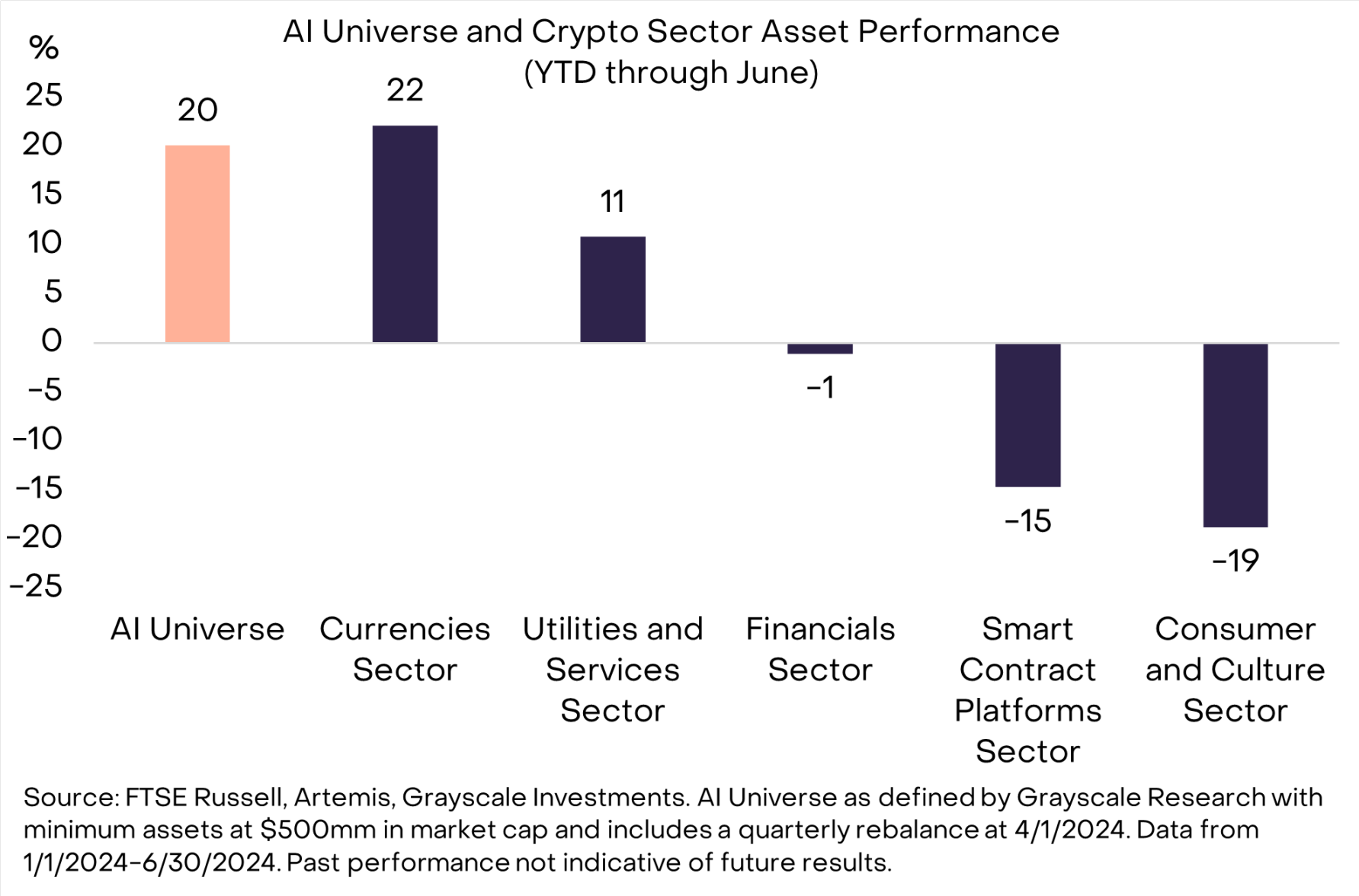
The intersection of cryptocurrency and AI is still in its early stages, but the market response is encouraging. As of May 2024, the return on AI concept crypto assets (defined by Grayscale Research as a cryptocurrency investment portfolio including NEAR, FET, RNDR, FIL, TAO, THETA, AKT, AGIX, WLD, AIOZ, TFUEL, GLM, PRIME, OCEAN, ARKM, and LTP) is 20%, second only to currency concept categories (Figure 1). Additionally, according to data provider Kaito, AI is currently the most popular "narrative" on social platforms compared to other themes such as DeFi, Layer 2, Memecoin, and real-world assets.
Recently, some prominent figures have begun embracing this emerging intersectional field, aiming to address the shortcomings of centralized AI. In March of this year, Emad Mostaque, the founder of the well-known AI company Stability AI, left the company to explore decentralized AI, stating "Now is the time to open up and decentralize AI." Cryptocurrency entrepreneur Erik Vorhees recently launched Venice.ai, a privacy-focused AI service with end-to-end encryption.

The Fusion of Cryptocurrency and AI
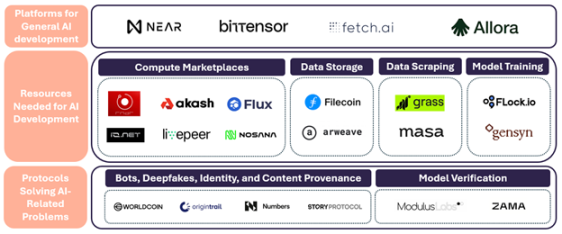
We can categorize the fusion of cryptocurrency and AI into three main subcategories:
- Infrastructure Layer: Networks that provide platforms for AI development (e.g., NEAR, TAO, FET);
- Resources for AI: Providing essential resources such as computing, storage, and data for AI development (e.g., RNDR, AKT, LPT, FIL, AR, MASA);
- Solving AI Problems: Attempting to address AI-related issues such as the rise of deepfakes and model verification (e.g., WLD, TRAC, NUM).

AI Infrastructure Networks
The first category provides permissionless open architectures designed specifically for AI development. These networks do not focus on a specific AI product or service but create the underlying infrastructure and incentive mechanisms for various AI applications.
NEAR stands out in this category, with its founders being co-authors of the "Transformer" architecture, which supports AI systems such as ChatGPT. However, the company recently leveraged its AI expertise to publish work on developing "user-owned AI" through a research department led by a former OpenAI research engineer advisor. In late June 2024, Near launched an AI incubator program for developing Near-native base models, AI application data platforms, AI agent frameworks, and computing markets.
Another notable example is Bittensor, a platform that uses the TAO token to economically incentivize AI development. Bittensor is the underlying platform for 38 subnetworks, each with different use cases such as chatbots, image generation, financial forecasting, language translation, model training, storage, and computation. The Bittensor network rewards the best miners and validators in each subnet with TAO tokens and provides developers with permissionless APIs to help build specific AI applications.
AI infrastructure networks also include other protocols such as Fetch.ai and Allora. Fetch.ai is a platform for developers to create complex AI agents, which recently merged with AGIX and OCEAN, with a total value of approximately 7.5 billion USD. Another is the Allora network, which focuses on applying AI to the financial sector, including automatic trading strategies for decentralized exchanges and prediction markets. Allora has not yet launched a token and raised a strategic financing round in June, totaling 35 million USD.
The second category is projects that provide resources for AI development in the form of computing, storage, or data.
The rise of AI has created an unprecedented demand for GPU computing resources. Decentralized GPU markets such as Render (RNDR), Akash (AKT), and Livepeer (LPT) provide idle GPU supplies for developers needing computation for model training, model inference, or rendering 3D generative AI. Render is estimated to provide around 10,000 GPUs, focusing on artists and generative AI, while Akash offers 400 GPUs, targeting AI developers and researchers. Meanwhile, Livepeer recently announced its new AI subnetwork plan, aiming to complete functions such as text-to-image, text-to-video, and image-to-video by August 2024.
In addition to the need for extensive computation, AI models also require a large amount of data. Therefore, there is a significant increase in demand for data storage. Data storage solutions such as Filecoin (FIL) and Arweave (AR) can serve as alternatives to storing AI data on centralized AWS servers. These solutions not only provide cost-effective and scalable storage but also enhance data security and integrity by eliminating single points of failure and reducing the risk of data leaks.
Finally, existing AI services such as OpenAI and Gemini continuously access real-time data through Bing and Google searches. This puts all other AI model developers outside of tech giants at a disadvantage. However, data fetching services such as Grass and Masa (MASA) can help create a fair competitive environment, as they allow individuals to commercialize their application data for AI model training while maintaining control and privacy over their personal data.
Addressing AI-Related Issues
The third category includes projects attempting to address issues related to artificial intelligence, including the proliferation of network robots and deepfakes.
A significant problem exacerbated by AI is the proliferation of network robots and false information. AI-generated deepfake content has already influenced presidential elections in India and Europe, and experts are "very afraid" that the upcoming presidential elections will be engulfed in a "tsunami of false information" driven by deepfakes. Projects aiming to help address issues related to deepfakes by establishing verifiable content sources include Origin Trail (TRAC), Numbers Protocol (NUM), and Story Protocol. Additionally, Worldcoin (WLD) attempts to address the issue of network robots by proving a person's humanity through unique biometric technology.
Another risk of artificial intelligence is ensuring trust in the models themselves. How can we trust that the AI results received have not been tampered with or manipulated? Currently, several protocols are working to address this issue through cryptography, zero-knowledge proofs, and fully homomorphic encryption (FHE), including Modulus Labs and Zama.
Conclusion
While these decentralized AI assets have made initial progress, we are still in the early stages of this intersectional field. Earlier this year, prominent venture capitalist Fred Wilson stated that artificial intelligence and cryptocurrency are "two sides of the same coin," and "Web3 will help us trust artificial intelligence." As the AI industry continues to mature, Grayscale Research believes that these cryptocurrency use cases related to AI will become increasingly important, with the potential for these two rapidly developing technologies to support each other and grow together.
Many signs indicate that the era of artificial intelligence is imminent, which will have far-reaching impacts, both positive and negative. By leveraging the characteristics of blockchain technology, we believe that cryptocurrency can ultimately help mitigate some of the dangers posed by artificial intelligence.
免责声明:本文章仅代表作者个人观点,不代表本平台的立场和观点。本文章仅供信息分享,不构成对任何人的任何投资建议。用户与作者之间的任何争议,与本平台无关。如网页中刊载的文章或图片涉及侵权,请提供相关的权利证明和身份证明发送邮件到support@aicoin.com,本平台相关工作人员将会进行核查。