The controversy over high FDV and low circulation tokens has been escalating recently, with the prices of tokens with low circulation and high FDV remaining low, and a large number of retail investors becoming "sacrificial lambs" for liquidity exits. The high FDV and low circulation of tokens can lead to significant selling pressure when unlocked in the future, which is detrimental to the long-term development of the project and ordinary investors. How to rationally evaluate the value of tokens with high FDV and low circulation has become a vexing issue.
1. Overview of Circulation, Market Cap, and FDV
Circulation, market cap, and FDV are important indicators for evaluating the value of cryptocurrency project tokens. They are interrelated and collectively influence a project's performance and potential in the market.
1.1 Circulating Supply
Circulating supply refers to the current quantity of a cryptocurrency asset available for trading in the market. This concept is often used to measure the liquidity and market participation of a cryptocurrency asset. Accurately estimating the circulating supply is crucial for investors because it directly affects the supply-demand relationship and price fluctuations of the asset in the market.
Circulating supply can be seen as the actual quantity of tokens freely tradable in the market. The calculation of circulating supply is generally based on the blockchain data of the project and public information from the issuer. Estimating circulating supply accurately is crucial for investors because it directly affects the supply-demand relationship and price fluctuations in the market.
1.2 Market Capitalization
Market capitalization refers to the current total market value of a cryptocurrency asset and is typically used to measure the scale and importance of the asset in the market. The calculation method for market capitalization is to multiply the circulating supply of the asset by the current price to obtain the total market value of the asset in the market.
Market capitalization plays an important role in the cryptocurrency market because it can reflect the overall level of market recognition and investment enthusiasm for the asset. A higher market capitalization usually implies greater market recognition and higher investor confidence, but it may also imply the existence of risks and bubbles.
1.3 Fully Diluted Valuation (FDV)
Fully diluted valuation refers to the total market value of a cryptocurrency project when considering the total quantity of tokens that could potentially be issued. It includes the currently circulating tokens of the project and all tokens that may be issued in the future.
The calculation method for FDV is to multiply the total supply of the project by the current price to obtain the total market value considering all potential issued tokens. This indicator is often used to measure the potential market scale and valuation ceiling of a project.
2. Impact of Circulation, Market Cap, and FDV on Token Value
Analyzing data such as circulation, market cap, and FDV provides a certain degree of understanding of a project's current status and potential, which helps investors make rational investment decisions.
2.1 How Circulation Affects Token Value
Circulation directly affects the liquidity and market participation of a project. Projects with low circulation may be more susceptible to price fluctuations because of the relatively small market trading volume, making them more vulnerable to the impact of large transactions. Additionally, low circulation may also increase the risk of market manipulation and price manipulation, as a small number of trades can have a significant impact on the market.
However, projects with low circulation may also have greater growth potential. When circulation is low, the supply in the market is relatively scarce, which may increase the pressure for price increases. Some investors may view low circulation as an opportunity for potential appreciation, as increased demand could lead to significant price increases.
2.2 How Market Cap Affects Token Value
Market cap is the total market value of a project in the market, calculated by multiplying the circulating supply by the current price. The size of the market cap reflects the overall level of market recognition and investment enthusiasm for the project. A higher market cap usually implies greater market recognition and higher investor confidence, while a lower market cap may indicate that the project has not been fully recognized by the market or has lower market participation.
For investors, market cap provides an indicator for measuring the scale and importance of a project. However, investors need to be aware that market cap does not necessarily reflect the true value of a project, as it is influenced by various factors such as market supply-demand relationships and investor sentiment. Therefore, investors need to consider market cap and other indicators comprehensively to evaluate the value of a project.
2.3 How FDV Affects Token Value
Understanding the fully diluted valuation (FDV) of a project helps investors assess the potential growth space and investment value of a project.
FDV can help investors better understand the potential market scale of a project. By comparing the current market cap with the fully diluted valuation, investors can assess the market recognition and growth potential of a project. A lower market cap relative to the fully diluted valuation may indicate that the project has not been fully recognized and has greater growth potential.
However, investors need to be aware that FDV is only a reference indicator, and actual market performance may be influenced by various factors. Therefore, investors should consider the market cap, circulation, and other factors comprehensively when evaluating the value of a project.
3. Current Market Status of Tokens with High FDV and Low Circulation
According to CoinGecko data, as of May 21st, among the top 300 cryptocurrencies by market cap, there are 60 with an MC/FDV ratio of less than 0.5, accounting for 20%. This means that for every 5 cryptocurrencies with higher market caps, there is one project with over half of its token supply yet to be unlocked.
Among the top 300 cryptocurrencies by market cap, there are 15 with an MC/FDV ratio of less than 0.2, including Worldcoin (WLD), Cheelee (CHEEL), Saga (SAGA), Ethena (ENA), Starknet (STRK), Jito (JTO), Ether.fi (ETHFI), ZetaChain (ZETA), Jupiter (JUP), Ondo (ONDO), AltLayer (ALT), Pixels (PIXEL), Dymension (DYM), Celestia (TIA), and Wormhole (W). The circulation of the first 4 tokens does not even exceed 10%, and they will be discussed in detail below:
Worldcoin: Worldcoin is an emerging global cryptocurrency aimed at becoming the largest and most inclusive cryptocurrency network in the world. The project has built a device called Orb, which can capture a person's eye image and convert it into a short digital code to verify their identity. Users will receive Worldcoin shares for free if they have not registered, and the original image does not need to be stored or uploaded. Some people believe that the FDV of WLD is already unreasonably high and that the price is unsustainable, merely a bubble riding on the AI trend. Others believe that the low circulation of WLD limits its value to the willingness of market makers.
According to the whitepaper, the maximum circulating supply of WLD is 143 million, with 100 million lent to overseas market makers and 43 million distributed to users verified through Orb. Since the official launch of the World App, a single user can receive a total of 77 WLD allowances. However, in some countries such as France and Hong Kong, WorldCoin faces regulatory pressure, leading to the inability of some users to withdraw tokens. Therefore, the circulating tokens of WLD in the current market include only two parts: tokens held by users who have received and withdrawn daily allowances through the app, and 10 million tokens held by market makers. This circulating supply accounts for only about 1.33% of the total supply of WLD. In addition, considering that the unlocking period for WLD is 150 days, the FDV of WLD is not indicative in the short term, and the claim of surpassing the market cap of OpenAI seems more like an AI meme.
Cheelee: Cheelee is a short video platform with a Watch to Earn mechanism, which pays all users who watch content. Its mission is to enable all users to earn money on social networks. Cheelee aims to drive Web3 and cryptocurrency adoption through the gaming community, where users can watch and generate game video content through their "NFT glasses," which can monitor the time spent watching videos and convert it into corresponding points for token rewards.
Cheelee is currently the most similar socialFi project to TikTok, with gameplay almost identical to TikTok, but with the concept of "watch to earn" and added gameplay elements related to gaming. Finally, it has achieved the most popular application in web2 within web3. For such projects, the best way is to "watch to earn" rather than to participate in the secondary market. The future upside depends on the intensity of promotion.
Ethena: Ethena is building derivative infrastructure to transform Ethereum into a global internet bond through Delta-neutral positions on stETH, creating the first interest-bearing stablecoin USDe. Inspired by Arthur Hayes' "Dust to Crust" article, EthenaLabs is dedicated to creating a derivative-backed stablecoin to address the significant reliance of cryptocurrencies on traditional banks. Their goal is to provide a decentralized, permissionless savings product for a wide audience. The synthetic dollar USDe aims to be the first crypto-native, censorship-resistant, scalable, and stable financial solution, achieved through Delta hedging against collateralized Ethereum.
Saga: Saga is a modular Layer1 platform tailored for the gaming industry. The Saga protocol simplifies the deployment process through Chainlets, a dedicated blockchain that developers can easily launch like deploying smart contracts, integrating key elements such as data availability, consensus, execution, and settlement to create a seamless product experience. The Saga protocol operates on a fully decentralized proof-of-stake model, ensuring that each Chainlet maintains the same high security standards as the Saga mainnet and uses the same set of validators. In less than two years, Saga has successfully attracted 350 projects, with 80% focusing on the gaming industry.
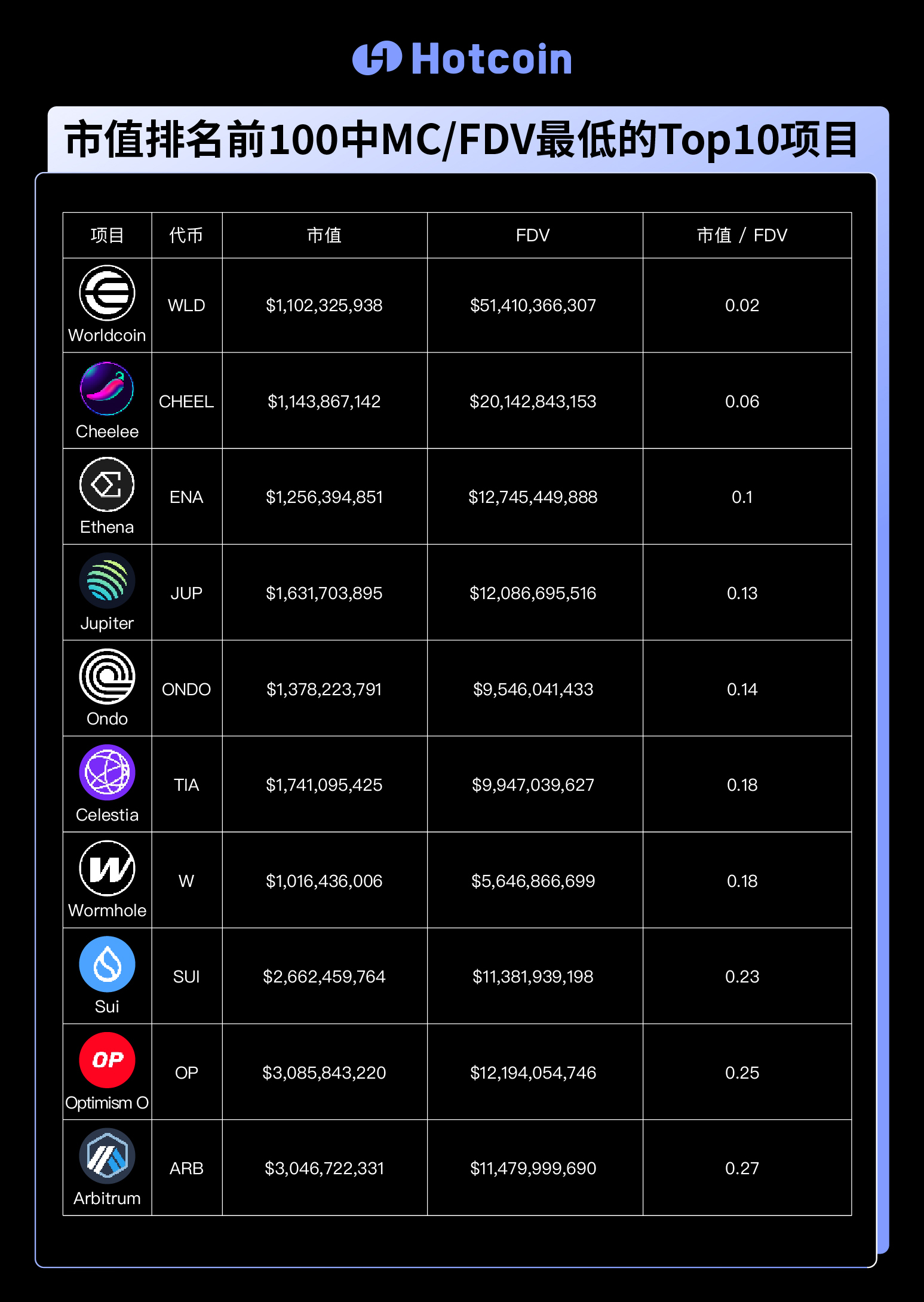
Top 10 projects with the lowest MC/FDV ratio among the top 100 market cap rankings:

4. Reasons and Impact of the Proliferation of High FDV and Low Circulation Tokens
The proliferation of high FDV and low circulation tokens is multifaceted. It is driven by factors such as the influx of capital from the private placement market, aggressive valuations, and optimistic market sentiment. However, this trend also brings negative impacts such as increased selling pressure and challenges for project selection, which require careful evaluation and handling by investors and project teams.
4.1 Reasons for the Proliferation of High FDV and Low Circulation Tokens 4.1.1 Influx of capital from the private placement market: Venture capital (VC) funds are increasingly consolidating their position in the crypto field, making private placement financing an important avenue for projects to raise funds. With the influx of capital, the influence of VC has increased, leading to higher valuations and an expansion of the scale of private placement financing.
4.1.2 Aggressive valuations: Optimistic market sentiment has driven investors' preference for high-valuation tokens, as they are willing to participate at higher prices. This sentiment also encourages venture capital firms to pay higher valuations in private placements, thereby raising the tokens' FDV.
4.1.3 Optimistic market sentiment: In a positive market environment, project teams are more likely to raise funds at higher valuations. This market sentiment makes investors more willing to participate in projects at high valuations, while also providing more fundraising opportunities for projects.
4.1.4 Promotion of point programs: The recent proliferation of point programs attracts users to participate in projects by offering point rewards, allowing users to win airdropped tokens through active participation in on-chain activities. This model leads to artificially high FDV at token listing, but as a large number of users sell the tokens after the airdrop ends, market performance deteriorates.
4.2 Analysis of the Impact of High FDV and Low Circulation on Tokens 4.2.1 Increased selling pressure: The proliferation of high FDV and low circulation tokens has led to a large influx of unlocked tokens into the market, increasing selling pressure. According to a Binance research report, approximately $155 billion worth of tokens are estimated to be unlocked from 2024 to 2030, which may have a negative impact on market prices.
4.2.2 Increased price volatility: High FDV and low circulation tokens typically have low circulation, with a large number of unlocked tokens. Market participants must pay more attention to the token's supply and unlocking schedule. When there is fluctuation in market circulation, price volatility may intensify.
4.2.3 Increased risk of market manipulation: The limited circulation of high FDV and low circulation tokens increases the risk of market manipulation. With a small amount of trading, market manipulation risk is heightened, providing more opportunities for manipulators. Manipulators can influence token prices through large transactions or market manipulation methods to profit.
4.2.4 Risk of value bubble: For high-quality projects with high demand, high FDV is seen as an opportunity for potential appreciation, as prices may experience significant increases with increased demand. However, if the growth in token demand does not keep up with the token inflation rate, high FDV may also imply the existence of risk and a bubble.
5. How to Properly Evaluate the Value of High FDV and Low Circulation Tokens
After discussing the phenomenon and driving factors of high FDV and low circulation tokens, it is important to delve into how to properly evaluate the value of these tokens. Despite enjoying high valuations in the market, investors need to rationally assess their potential value and long-term prospects, avoiding blindly following trends or being influenced by market sentiment.
Team background and strength: First, examine the project team's background and strength. A team composed of experienced developers and industry experts may be more capable of realizing the project's vision and goals, thereby increasing the token's long-term value.
Project vision and technical implementation: Evaluate whether the project's vision is practically feasible and whether its technical implementation can solve real-world problems. Projects with innovation and foresight typically have higher growth potential.
Community and user base: Observe the project's community and user base, including activity on social media, user engagement, and the quality of community development. An active, loyal community may increase the token's liquidity and market demand.
Real-world application and adoption: Understand the project's real-world application scenarios and adoption, as well as its partnerships with real-world entities. Whether the project has been applied in practical scenarios and has support from partners can impact the token's value.
Competitive advantage and differentiation: Analyze the project's advantages and differentiation in the industry competition, as well as whether it has sustainable competitive advantages. Projects with unique technology, business models, or market positioning may be more attractive.
Financial condition and fund management: Review the project's financial condition and fund management, including token allocation, fund operations, and project development plans. Sound fund management and transparent financial reporting can increase investor trust and project sustainability.
Risks and uncertainties: Identify the project's risk and uncertainty factors, including technological, market, and legal risks. Understanding and evaluating the impact of these risk factors on the token's value can help make reasonable investment decisions.
Evaluating the value of high FDV and low circulation tokens requires considering multiple factors and conducting analysis and judgment with a rational, objective attitude. Investors should choose appropriate investment strategies based on their risk tolerance and investment objectives, and closely monitor the project's development dynamics and market performance to adjust their investment portfolios in a timely manner.
6. Response and Prospects of High FDV and Low Circulation Tokens
In response to the recent issue of the proliferation of high FDV and low circulation tokens, cryptocurrency exchanges Binance and OKX have adjusted their listing strategies, attracting widespread attention in the market. Binance has stated that it will first support small and medium-sized cryptocurrency projects, inviting high-quality teams and projects to apply for Binance listing projects, including direct listings, launchpools, and megadrops. The aim is to promote the development of the blockchain ecosystem by strengthening support for small and medium-sized cryptocurrency projects with strong fundamentals, organic community bases, sustainable business models, and industry responsibility.
However, some voices have pointed out that the listing adjustments by exchanges such as Binance are only addressing the symptoms rather than the root cause. The lack of liquidity in the market remains a key issue, and low market cap does not necessarily mean good performance in the secondary market. Therefore, retail investors need to be cautious in their investment strategies, avoiding excessive reliance on market hype and short-term fluctuations.
For high FDV and low circulation tokens, exchanges should consider lowering the listing prices of tokens and adhere to reasonable lock-up period principles. Project teams should focus on token distribution and unlocking schedules, and strive to build valuable products and healthy community ecosystems. Venture capitalists need to maintain price discipline and encourage founders to maintain a realistic attitude. Retail investors need to carefully select projects, pay attention to token unlocking situations, and the alignment of internal and external values.
In summary, high FDV and low circulation tokens not only affect the development and market performance of the projects themselves, but also impact the operation and development of the entire crypto ecosystem. Project teams of high FDV and low circulation tokens need to build an ecosystem that incentivizes contributions and benefits from all parties, to ensure the robust development and sustained growth of the tokens.
Hotcoin pays close attention to the potential value and long-term prospects of projects and will continue to monitor and list high-quality assets. For crypto investments, come to Hotcoin, where the hottest high-quality assets are reached first, staying one step ahead!
免责声明:本文章仅代表作者个人观点,不代表本平台的立场和观点。本文章仅供信息分享,不构成对任何人的任何投资建议。用户与作者之间的任何争议,与本平台无关。如网页中刊载的文章或图片涉及侵权,请提供相关的权利证明和身份证明发送邮件到support@aicoin.com,本平台相关工作人员将会进行核查。