L2 and L3 are different technologies in the cryptocurrency field, used to improve the scalability and efficiency of blockchain networks. Currently, the development of L3 is very poor.
Article by: @0xMarcB
Translated by: Plain Blockchain
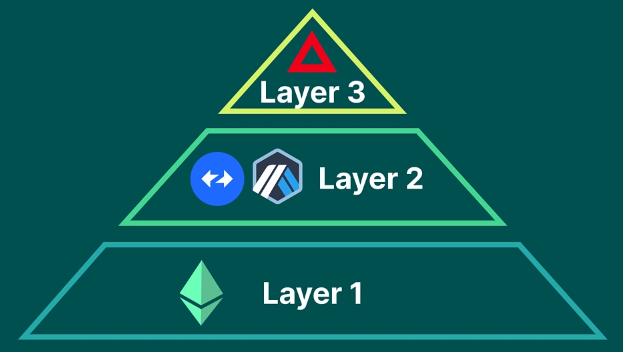
L2 (Layer 2 solution) and L3 (Layer 3 solution) are two different technical solutions in the cryptocurrency field, aimed at improving the scalability and efficiency of blockchain networks.
L2 is a second-layer protocol built on top of the main blockchain Layer1 (usually Ethereum). They alleviate the burden on the main chain by moving the processing of transactions and smart contracts from the main chain to side chains or shard networks on-chain. L2 solutions typically have faster transaction confirmation times and lower transaction costs, while supporting larger transaction volumes. Common L2 technologies include Plasma, Rollups, and Sidechains.
In contrast, L3 is a third-layer solution built on top of L2. They aim to further improve the scalability of the blockchain and introduce new features and capabilities. L3 protocols typically have advanced features such as cross-chain interoperability, customized smart contracts, and stronger privacy protection. The goal of L3 is to provide users with more choices and flexibility to meet different blockchain needs.
Although L3 technology has some innovative advantages, it has some potential disadvantages compared to L2. For example, L3 may require transaction confirmation through the L2 network, resulting in longer transaction processing times. In addition, as L3 is a relatively new technology, there may be challenges in development and security.
Today, let's take a look at the analysis of L2 and L3 by the founder of Horseshoe:
Don't fall for marketing tricks, the promotion of inferior technology, or even worse, attempts to secretly overthrow Ethereum.
I think the development of L3 is worse than L2. Why is L3 worse than L2?
1) You can customize all aspects of L2 just like L3. Polygon CDK supports you.
2) You can use native GasToken on L2 just like L3. Polygon CDK supports you.
3) You can seamlessly interoperate between L2, L3, and even L1 without needing L3. AggLayer supports you.
4) You can directly enter L2 from any trading platform as long as there is another chain connected to AggLayer and able to enter from the trading platform. This is more flexible and more conducive to the above L3 than needing to be listed on every trading platform. AggLayer + Polygon PoS supports you. The X layer connected to AggLayer also supports you.
5) You can easily distribute L2 transaction costs across multiple L2 and L3 just like L3. AggLayer supports you.
6) As L2, you can have sovereignty and enjoy all the above benefits, while L3 is subject to any restrictions from L2.
7) L2 allows you to quickly return to Ethereum frequently. L3 cannot, as they always need to go through L2 control.
So why bother to build L3 on L2?
Developers of L2 do this to increase their block space requirements on L2 and lock in the network effects of L3. They use L3 to achieve this because they lack zero-knowledge technology and cannot develop secure interoperability between L2, thus needing a marketing trick to make up for it.
In some cases, they may believe they can create enough network effects to eventually launch their own validator set and have enough economic security to replace Ethereum. This is a dangerous game, and everyone should remain vigilant to prevent the abuse of market power.
Should building L3 be allowed?
Of course! Cryptocurrency is about freedom. Neither I nor Polygon Labs will try to dictate what people can build. Some L3 is built using Polygon technology. We don't think it's necessary, although it's actually worse than building L2, but what right do we have to stop people from making their own choices?
免责声明:本文章仅代表作者个人观点,不代表本平台的立场和观点。本文章仅供信息分享,不构成对任何人的任何投资建议。用户与作者之间的任何争议,与本平台无关。如网页中刊载的文章或图片涉及侵权,请提供相关的权利证明和身份证明发送邮件到support@aicoin.com,本平台相关工作人员将会进行核查。


