Author: Zach Pandl
Translation: Frank, Foresight News
- Asset tokenization refers to registering ownership of assets on blockchain infrastructure in tokenized form, allowing assets to benefit from the functionality of the blockchain, such as more efficient settlement and the ability to interact with smart contracts.
- The modern financial system is already quite efficient, and tokenization itself may not bring immediate efficiency improvements. Instead, we believe the main benefits may come from bringing users, assets, and applications together on a common global platform.
- From the perspective of the crypto market, while various assets can benefit from the trend of tokenization, the most potential may lie in protocols that can provide a universal global platform. Currently, Grayscale Research believes that the Ethereum blockchain is most likely to achieve this goal in the future.
Public blockchains can be seen as a general technology with many potential use cases, from payments to video games to digital identity systems. The value of this technology partly comes from introducing various applications onto a permissionless and open architecture platform. When users, capital, and applications are concentrated in one place, everyone in the ecosystem can benefit from network effects.
Tokenization is one of the many applications of public blockchain technology. In some cases, if existing "back-end" processes are very cumbersome, transferring asset management to blockchain infrastructure may immediately improve efficiency. However, for many types of assets (such as listed stocks), the current digital infrastructure works quite well, and whether public blockchains can play a better role is not obvious. In these cases, the potential benefits of tokenization may come from network effects: by moving global assets to a common platform, we may create a more powerful, accessible, and cost-effective financial system.
From the perspective of the crypto market, while various assets can benefit from the trend of tokenization, the most potential may lie in protocols that can serve as a unified platform for tokenized assets, investors, and related applications. Currently, Grayscale Research believes that the Ethereum blockchain is most likely to achieve this goal in the future.
System Upgrade
As blockchain becomes more widely adopted, securities may be fully issued and tracked on-chain. However, currently, ownership of securities income and physical assets such as real estate, physical commodities, and collectibles are recorded in traditional off-chain ledgers (often electronic ledger accounts). Tokenization refers to the process of registering ownership of assets on blockchain infrastructure so that market participants can benefit from the functionality of the blockchain. By design, token prices based on blockchain should closely track the prices of underlying reference assets.
Some benefits of converting ownership of assets to blockchain-based tokens may include:
- Settlement efficiency: Blockchain transactions can settle almost instantly and can be set to exchange assets under payment conditions, reducing the risk of settlement failure.
- Programmability: Tokenized assets can be integrated into software applications to allow for added functionality. For example, this may include conditional transfers based on off-chain information (such as compliance approvals) or using tokens as collateral for decentralized lending platforms.
- Accessibility: Like the internet itself, blockchain is not restricted by national borders, so tokenized assets can provide access to global capital markets for investors in a wider range of countries or regions. Blockchain can also facilitate access to new asset types through open segmentation.
- Cost reduction: By increasing automation and reducing the role of intermediaries, tokenized assets can reduce the issuer's costs by lowering underwriting fees and interest rates.
Researchers at the Bank for International Settlements (BIS) have defined a tokenized "continuum" to consider how this process affects specific markets. On one hand are markets that still require a significant amount of manual workflow, such as real estate or bank loans. These assets may be difficult to tokenize, but the process can create meaningful efficiency improvements.
On the other hand, many other markets currently use electronic ledger systems with fairly high efficiency, such as listed stocks, mutual funds and ETFs, and listed derivatives. These assets may be more easily tokenized, but the efficiency improvements provided by the process are more limited.
The best candidate assets for tokenization may lie somewhere in the middle of the BIS continuum: markets that can benefit from slightly better electronic record keeping and smart contract functionality—this list may include many types of fixed income securities, such as government bonds and structured products.
However, as further discussed below, the greatest benefits may come from moving all assets to a unified global platform.
Current and Future Tokenization
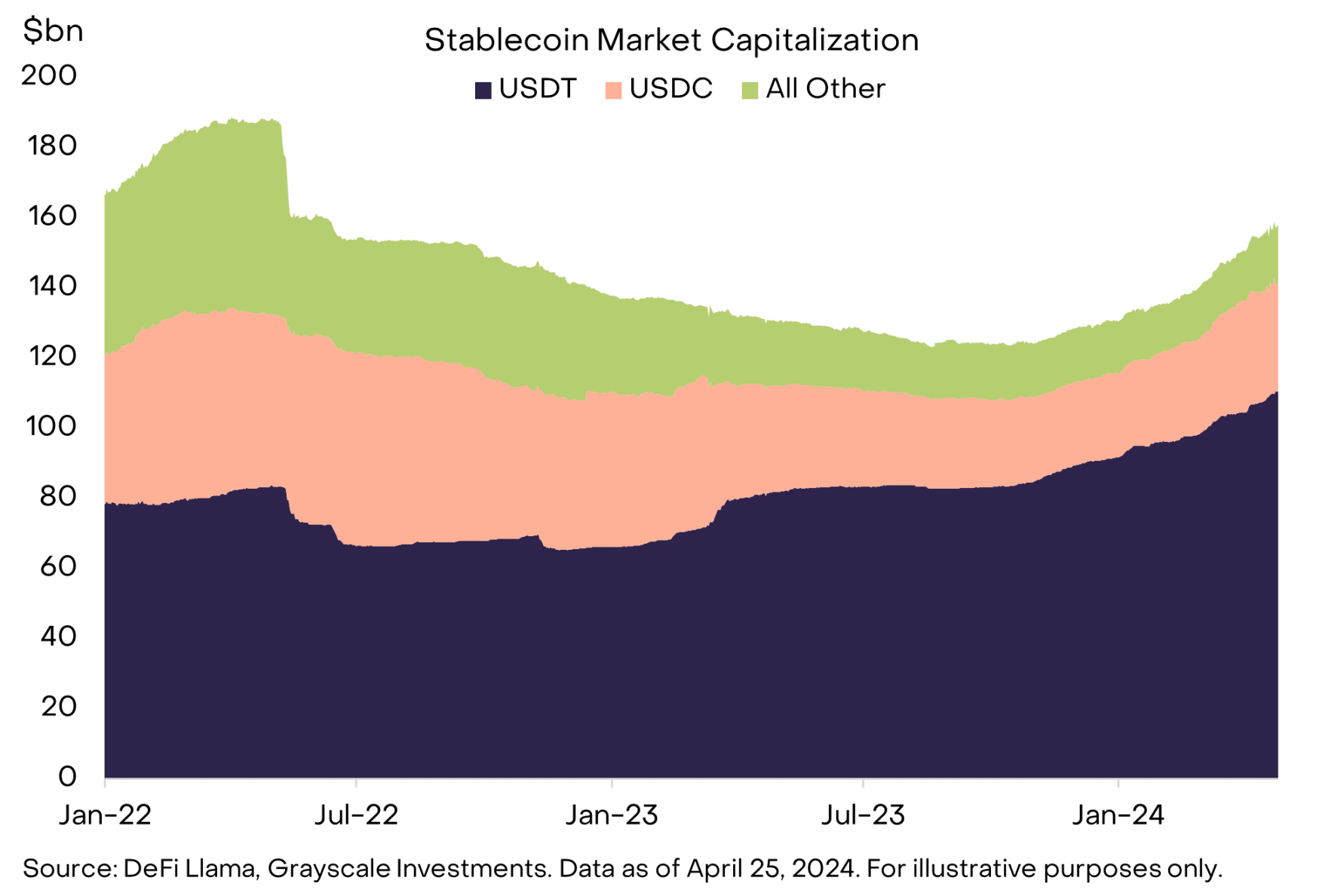
The first application of tokenization technology to find product-market fit (PMF) is stablecoins, which tokenize the simplest and most liquid asset among all assets—cash.
The total market value of stablecoins has now reached 158 billion US dollars, with Tether (USDT) and USDC leading the way (Chart 1). Stablecoins come in various forms, but USDT and USDC can be considered fiat-backed stablecoins.
They operate similarly to other tokenized assets: traditional assets are held by off-chain custodians, and tokenized representations can be held in blockchain wallets. Then, this form of digital cash can be used for payments, benefiting from the potential of almost instant settlement on the blockchain, lower costs, and/or interaction with smart contracts.
Chart 1: Stablecoins have found product-market fit

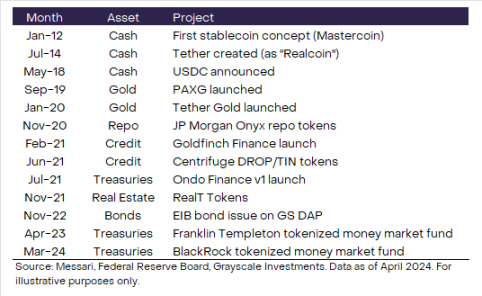
Following stablecoins, the next widely adopted tokenized asset is gold (Chart 2). The total market value of the two largest projects, Tether Gold (XAUt) and PAX Gold (PAXG), is approximately 1 billion US dollars. Although there are many ways to invest in gold, these products provide some blockchain functionality, such as the ability to transfer risk outside of weekends or traditional market hours. This functionality has shown its utility in recent geopolitical tensions in the Middle East: when other markets were closed, XAUt and PAXG both experienced significant increases in the week of April 13-14.
Chart 2: Timeline of selected tokenized projects

The latest wave of tokenization focuses on two very different markets: US Treasuries and closely related assets, and credit products.
Tokenized US Treasury products are designed as cash equivalents and can be seen as an interest-bearing stablecoin alternative. According to data provider RWA.xyz, the weighted average maturity of all existing products currently offered is less than two years.
In other words, these products are designed to provide income and serve a function similar to cash. When cash rates are close to zero, the opportunity cost of holding stablecoins is relatively low. But now, with US dollar rates close to 5%, investors are more motivated to seek alternative options that can generate income, which may promote the development of tokenized Treasury products.
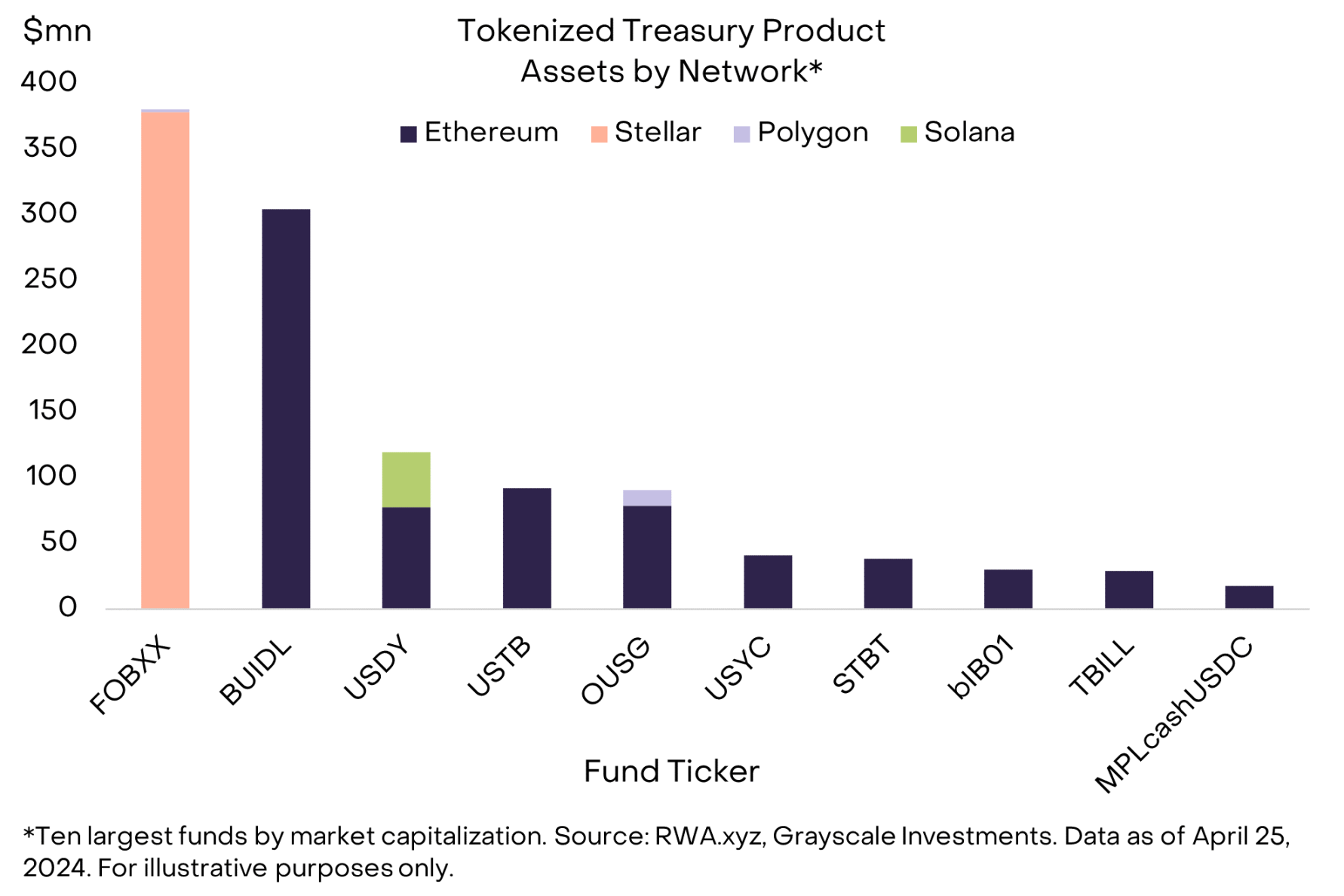
Currently, circulating tokenized Treasury funds, led by Franklin On-Chain US Government Money Fund (FOBXX) and BlackRock Institutional Dollar Digital Liquidity Fund (BUIDL), have exceeded 1 billion US dollars (Chart 3). Many existing products have been launched on the Ethereum network and seem to be targeting crypto-native institutions, such as cryptocurrency hedge funds and DAOs (decentralized autonomous organizations).
However, the largest fund, FOBXX, takes a different approach: it is launched on the Stellar network and is open to retail investors through a mobile application. In summary, about 60% of tokenized Treasury fund AUM is on Ethereum, 30% is on the Stellar network, and the rest is on other blockchains.
Chart 3: About 60% of tokenized Treasury products are on Ethereum

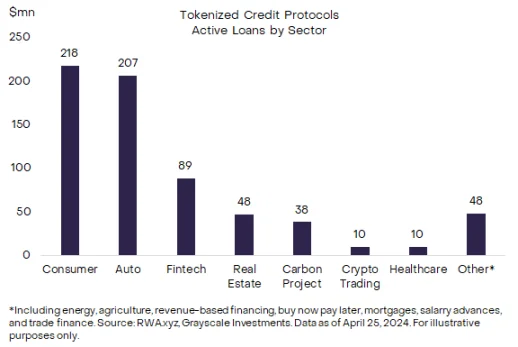
Various companies have also launched tokenized credit products. This is a diverse category, including direct lending to individual counterparties, pools of structured credit products (such as ABS, CLO), and loans to intermediaries in specific industries (such as real estate financing, emerging markets). Although these products may carry risks and complexities, and are currently designed for institutional investors only, their goal is simple—to guide capital from lenders to borrowers through blockchain infrastructure. According to RWA.xyz, there are currently $6.12 billion in active loans in this category, with an average yield of approximately 10% (Chart 4).
Chart 4: Tokenized credit products cover a diverse mix of borrowers

Tokenization technology has many other potential applications, but few applications have moved beyond the experimental stage. For example, the tokenized real estate platform RealT offers a way for investors outside the United States to own fractional property; the protocol currently locks in a total value of $103 million. There is also hope that tokenized private equity could provide a channel for the alternative investment industry to reach a broader set of investors, but whether these new issuance channels will make a significant contribution to the industry's AUM remains to be seen.
Various fixed income securities have been directly issued on-chain, with issuers including both public sector issuers (such as the European Investment Bank) and private sector issuers (such as Siemens). While attempts have been made to tokenize stocks in the past, we suspect that these projects will need clearer regulatory guidelines before making further progress.
If adoption continues, tokenization has the potential to drive a significant amount of blockchain activity and fee income, as the potential market size is enormous—just in the United States, US Treasuries represent a $26 trillion market, and the total non-financial sector loans domestically amount to $36 trillion. Currently, the scale of on-chain tokenized assets represents only a tiny fraction of these totals. However, for these products to develop beyond today's crypto-native institutions, they will need to more effectively connect with existing pools of capital. This may require establishing connections with brokers or bank accounts, or providing investors with compelling reasons to move their assets on-chain.
Revolution Will Not Happen on Private Chains
A common misconception is that tokenization may not benefit crypto assets because the activity will take place on private permissioned blockchains, rather than public permissionless blockchains like Ethereum. While banks have indeed attempted to use private blockchain infrastructure (e.g., JPMorgan Onyx, HSBC Orion, and Goldman Sachs DAP), this at least partly reflects current regulations that prevent deposit-taking institutions from interacting with public chains, a restriction that asset management firms, not subject to these limitations, have been operating on public chains or hybrid public-private chains.
In fact, almost all successful tokenization applications to date (such as stablecoins, tokenized government bonds, and tokenized credit products) have been issued on public blockchain infrastructure.
The reason is simple: that's where the users are.
We expect that moving certain assets to blockchain infrastructure will bring efficiency improvements, but the greater potential of tokenization lies in seamlessly connecting assets and investors (or borrowers and lenders) from around the world and building richer experiences through interoperable applications.
Public blockchains have many other applications besides tokenization, making them natural centers for user assets and activities over time. Therefore, they may continue to be the primary destination for asset issuers and developers of open finance applications. We believe that private permissioned blockchains operated by companies or national governments are unlikely to credibly provide the global neutral platform needed to custody the world's tokenized assets.
Trading, Fees, and Value Accrual
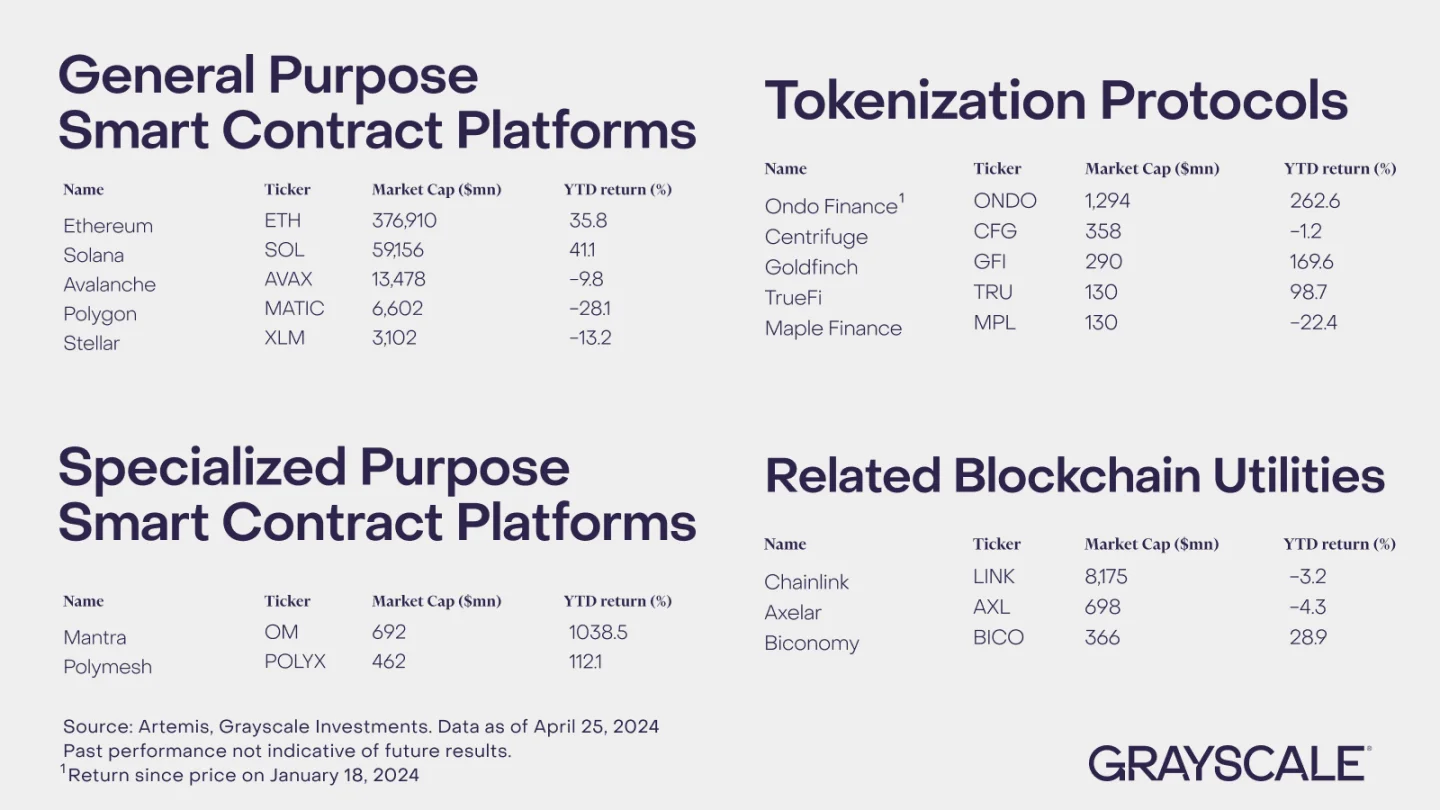
Blockchain transactions typically generate fees, which can flow directly to token holders (e.g., dividends) or indirectly to token holders through reducing token supply (e.g., buybacks). Therefore, if asset tokenization can generate trading activity and fees, it can accrue value to blockchain-based tokens. However, the mechanism for this to occur will depend on protocol type and token properties (Chart 5).
Chart 5: Assets from various crypto industries may all benefit from tokenization

Some components of our smart contract platform in the crypto space should see the most direct impact. The L1 blockchains in this segment (perhaps eventually some components of their L2 ecosystems as well) can serve as universal global platforms for tokenized assets. The native tokens of these protocols are typically used to pay transaction fees ("Gas") and may receive staking rewards or benefit from reducing token supply.
There is fierce competition in the smart contract platform crypto space, but the Ethereum ecosystem still dominates other blockchains in terms of users, assets (locked-in total value), and decentralized applications. Additionally, we believe Ethereum can be considered highly decentralized and neutral to network participants, which may be a necessary condition for any global tokenized asset platform.
Therefore, we believe Ethereum is currently in the most advantageous position among smart contract blockchains to benefit from the trend of tokenization. Other smart contract platforms that may benefit from the tokenization trend include Avalanche (a platform used by financial institutions for various proof-of-concept projects), Polygon, and Stellar, as well as L1 blockchains designed specifically for tokenization, such as Mantra and Polymesh.
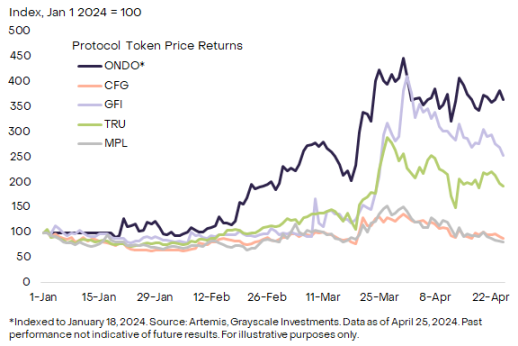
The next set of beneficiaries includes the tokenization protocols themselves, which provide platforms for bringing traditional assets into on-chain software applications (Chart 6). Many such providers do not govern tokens (e.g., Securitize, Superstate), but some do.
For example, Ondo Finance, which issues tokenized government bond products, and Centrifuge, a part of the financial crypto space that tokenizes credit products, should be considered by investors for the nature of governance rights they confer and whether they confer any rights to protocol revenue before considering these tokens.
Chart 6: Year-to-date returns for some tokenization protocols

Finally, the increase in blockchain activity resulting from tokenization may support many other components in the crypto ecosystem. For example, Chainlink hopes its Cross-Chain Interoperability Protocol (CCIP) can provide core infrastructure for message passing data across blockchains (including private and public chains). Similarly, the Biconomy protocol provides certain technical processes that can help traditional financial institutions interact with blockchain technology (e.g., "paymaster" services, allowing users to pay gas fees with tokens other than native blockchain tokens).
Chainlink and Biconomy are both part of our utility and service crypto space.
Tokenization Vision
In conclusion, many digital business use cases are transitioning from closed platforms hosted by centralized intermediaries to open and decentralized platforms based on public blockchain infrastructure, and tokenization is just one of many blockchain adoption trends.
But given the scale and scope of global capital markets, it may be an important trend, and if public chains can match borrowers and lenders (or asset issuers and investors) and demediate existing fintech, the increase in network activity should accrue value to public chain tokens.
免责声明:本文章仅代表作者个人观点,不代表本平台的立场和观点。本文章仅供信息分享,不构成对任何人的任何投资建议。用户与作者之间的任何争议,与本平台无关。如网页中刊载的文章或图片涉及侵权,请提供相关的权利证明和身份证明发送邮件到support@aicoin.com,本平台相关工作人员将会进行核查。