Ordinals After the wave and halving, there is a dormant BTC fund pool of over a trillion dollars, which urgently needs a solution that balances security and economy.
Author: Tyler
2023 is undoubtedly a turning point for the Bitcoin ecosystem.
Since the emergence of Ethereum and public chain ecosystems, whether it was the ICO frenzy in 2017, the DeFi boom in 2020, or the subsequent NFT narrative, almost every industry carnival in recent years has rarely seen the shadow of Bitcoin, and there has even been a trend of gradually leaving the Bitcoin ecosystem to dance alone.
It wasn't until the 2023 Ordinals craze erupted that BTC finally stopped being absent and completely changed the overall fee rate model of Bitcoin. With the dust settling after the fourth halving, its network operation further relies on fee income, which will undoubtedly profoundly affect the programmability of Bitcoin and the construction of on-chain ecosystems.
Against this background, this article will focus on the programmability of Bitcoin and discuss Rollux's Bitcoin L2 solution, to see if Rollux can take advantage of the evolving trend of Bitcoin's overall fee rate model to activate the BTC held by holders, the highest-quality and largest-volume native encrypted asset, and thus stir up this potential new track with an imagination space of up to hundreds of billions of dollars.
The question of Bitcoin L2: How to leverage dormant BTC assets
Incrementality is the core primitive of Web3's breakthrough, so it wasn't until the second half of last year that the Bitcoin L2 trend began to flourish.
After all, before 2023, Bitcoin was once excluded from innovative waves such as DeFi and NFT, only possessing "orthodox cognition" and total market value advantages. However, the inscription craze brought about by Ordinals in 2023 not only directly increased the richness of assets in the Bitcoin ecosystem but also introduced a huge amount of funds, users, and developers into the Bitcoin ecosystem through the inscription channel.
More importantly, the hot narrative of Ordinals and Bitcoin L2 also finally made the market realize that the $1.13 trillion volume of Bitcoin (latest CoinGecko data as of May 2, 2024) is the largest "dormant fund pool" in the encrypted world. The "programmability" of Bitcoin is the biggest stumbling block to activating this trillion-dollar asset:
The original Bitcoin chain cannot support larger funds and richer use cases, such as creating swaps, lending, liquidity mining, and a series of applications. Even if only 10%-20% of the dormant BTC is leveraged, it will create a new encrypted track worth hundreds of billions of dollars.
In his article "Reassessing the Programmability of Bitcoin," Pantera partner Franklin Bi clearly pointed out that if DeFi on Bitcoin reaches the same proportion as on Ethereum, the total value of DeFi applications on Bitcoin is expected to reach $225 billion (25% of Bitcoin's market value). Over time, its scale may fluctuate between $72 billion and $450 billion (8% and 50%).
Against this background, the programmability of Bitcoin has gradually become the core issue in the encrypted world. Building a prosperous DeFi application layer on the current Bitcoin ecosystem is destined to be the mainstream new hot narrative.
The market is also actively shifting. In the past six months, in addition to well-known old projects such as Stacks, RSK, and Liquid, new solutions such as BitVM, Merlin, B² Network, and even Nervos have provided new ideas. These L2 solutions aim to leverage programmability to create a series of DeFi applications such as swaps, lending, and liquidity mining, thereby unlocking the dormant trillion-dollar BTC assets.
But to be honest, history is always repeating itself. As early as the DeFi Summer of 2020, there were many attempts to release Bitcoin asset liquidity, with the most significant being bridging to the Ethereum ecosystem—pledging BTC in "wrapped" form, such as renBTC, WBTC, and tBTC during the DeFi frenzy of that year. Users could pledge BTC to obtain corresponding wrapped tokens, thereby bridging liquidity to the Ethereum ecosystem and participating in DeFi and other on-chain scenarios through coupling with the Ethereum ecosystem.
This "cross-chain bridge + EVM" form is actually the core play of most so-called Bitcoin L2 solutions at present. But does this kind of solution really appeal to BTC holders?
Not necessarily.
Fundamentally, most of these emerging Bitcoin L2 projects on the market have a huge risk of homogenization, and more than half of the new projects are destined to fail—developing them requires a continuous stream of funds to help expand the ecosystem and developer community. In the current context, most Bitcoin L2 newcomers lack this long-term competitiveness.
In addition, compared to complex on-chain Lego combinations such as DeFi, many BTC OGs or Maxis do not have the motivation or dare to take the risk of crossing too much BTC to the Ethereum ecosystem to speculate on unknown returns. For them, losing high-yield opportunities means losing a lot, but losing security undoubtedly means losing everything.
Therefore, the core focus of Bitcoin L2 is to solve the problems that Ethereum has not solved, achieve differentiated competition, and from this perspective, it seems that the key to activating the dormant trillion-dollar encrypted asset pool of Bitcoin lies in how to balance security and open up the narrative space of Bitcoin's programmability.
And Rollux's approach is also in line with this—being an EVM-compatible network based on Bitcoin's joint mining launched by Syscoin, Rollux's core positioning is a "shared EVM L2 expansion solution with Bitcoin security," which means maintaining network security through Bitcoin miners and Syscoin's L1 data availability (DA).
How to safely activate Bitcoin's programmability?
So let's take Rollux as an example to explore how to safely activate Bitcoin's programmability.
In my understanding, if I were to summarize the core architecture of Rollux in one sentence, it essentially provides a BTC-native security-based EVM-compatible solution, which means binding security to Bitcoin while aligning with the EVM ecosystem in terms of ecology, so it can be seen as an EVM-compatible BTC smart contract layer.
Binding security to Bitcoin
We need to first clarify a premise: currently, the vast majority of so-called "Bitcoin L2" solutions on the market are still based on the PoS chain concept—security essentially comes from the confiscatability of the staked assets: if the staker (or the validating node representing it) attacks the PoS network consensus, attempting to fork it, then its staked assets will be partially or completely confiscated.
This is undoubtedly far less secure than the security of the Bitcoin PoW chain, so Rollux takes a different approach, choosing to directly bind security to Bitcoin, raising its security to a level comparable to that of the Bitcoin main chain, thereby completely dispelling the doubts of BTC OGs or Maxis.
So how does it achieve the binding of Bitcoin's original chain security without requiring a Bitcoin network upgrade fork or the premise of a cross-chain bridge?
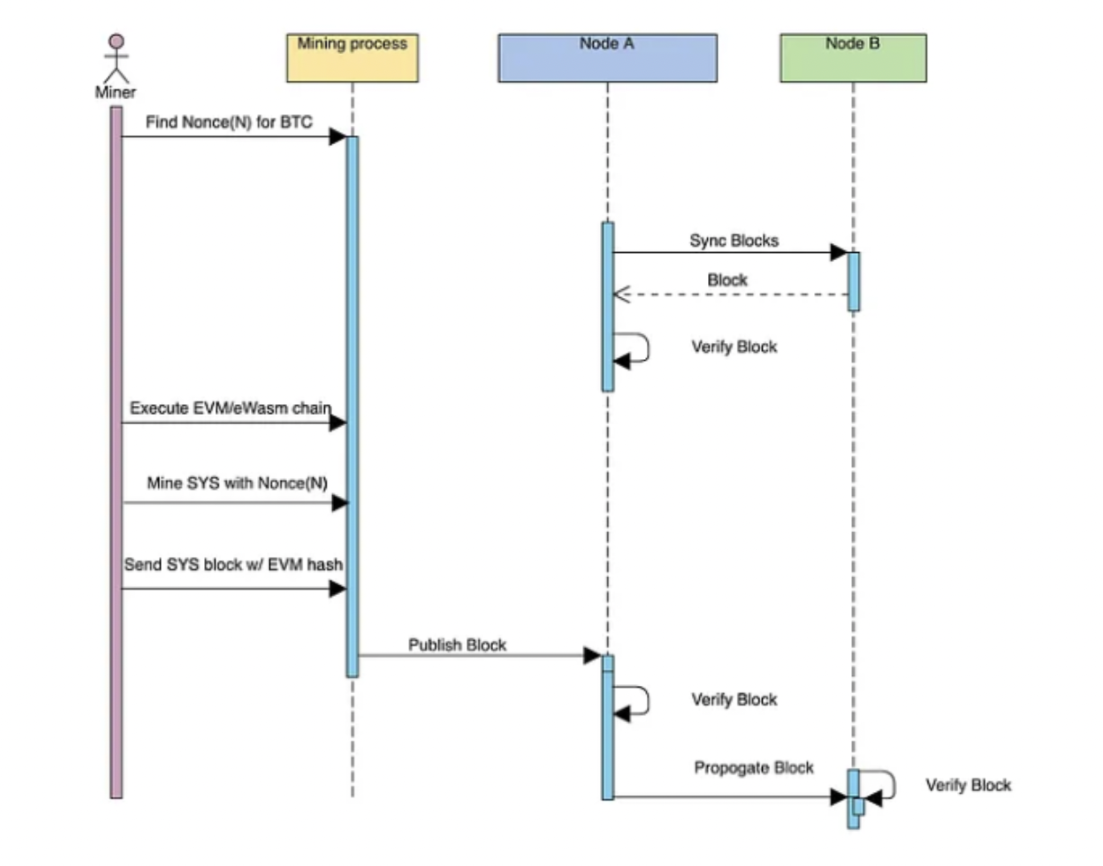
The logic behind it is also very simple, it is through the mechanism design of "joint mining"—Rollux's joint mining is derived from Syscoin, because Rollux is an Optimistic Rollup running on Syscoin NEVM (Network Enhanced Virtual Machine), it shares the security provided by Bitcoin miners with Syscoin:
The Syscoin network operates on a dual-chain architecture, with two parallel blockchains running simultaneously in Syscoin Core—Syscoin UTXO (Bitcoin standard) and Syscoin NEVM (Ethereum standard).
As of April 2022, it has obtained support from about 60% of the hash rate of the Bitcoin network, which to some extent directly converts the network hash power of Bitcoin into its own security guarantee, obtaining a natural security advantage from the ground up.

Aligning with the EVM Ecosystem
Furthermore, since Rollux operates on Syscoin NEVM (Network Enhanced Virtual Machine) as an Optimistic Rollup, it essentially benefits from the cross-chain interoperability services provided by the EVM ecosystem:
By being EVM-compatible, it allows developers and existing applications based on Ethereum to migrate seamlessly, facilitating further expansion of the ecosystem and enabling developers to deploy products quickly, thus rapidly gaining momentum.
For example, developers of DApps on EVM networks such as Ethereum, Arbitrum, and Optimism can seamlessly migrate to Rollux and quickly build swap, lending, and liquidity staking DeFi scenarios on Rollux, bringing more possibilities to the ecosystem.
In other words, a large amount of Bitcoin network assets can be guided into the smart contract ecosystem of Rollux, promoting the release of liquidity, allowing users to participate in various smart contract applications through Rollux, such as staking, DeFi, social, and even more complex financial derivative markets, greatly expanding the range and value of Bitcoin assets.
This can be coupled with multiple EVM ecosystems such as Ethereum, for example, supporting the creation of USDT/USDC pools in Curve-like applications, exchanging other encrypted assets or providing LP in Uniswap-like applications, and collateralizing and lending encrypted assets in Aave-like applications, to gain yields in diverse DeFi scenarios.
In addition, Rollux's data availability solution gives a green light to the economic construction of its on-chain ecosystem, with the core lever being the BitcoinDA protocol (PoDA) introduced by Syscoin—through collaboration with the ZK-based interoperability protocol zkBridge, Rollux shares Bitcoin security while also providing an extremely low-cost transaction and usage experience.
As a scalable DA, BitcoinDA is designed for various Rollups to protect various L2s by implementing L1 data availability. However, compared to Ethereum's Proto-Danksharding and Celestia, it differs in the way data is stored, presented, pruned, and the calculation of fees:
By default, the Keccak256 hash of the complete data blob is stored on L1, assuming that at least one honest party will archive the blob within a time window of at least 6 hours.
This is essentially similar to the honest assumption made when synchronizing Bitcoin nodes (at least one honest node), and after this time window, the blob will be pruned from the network cache, while its hash value remains on-chain.
The entire process is essentially a "four-step" logic:
- Obtain stBTC, where Bitcoin miners can obtain stBTC with returns equivalent to Bitcoin difficulty through normal mining, without the risk of slashing, laying the foundation for security for subsequent steps;
- Create and operate the Eigen layer, then create and operate an Eigen layer with two specific AVS services—cross-chain services and DA services, both using stBTC to provide security;
- Income and security enhancement, as demand increases, security also improves, and it creates income for Bitcoin holders, so theoretically, this will form a positive cycle, incentivizing more support for Eigen services and providing security;
- Modularize the entire Bitcoin layer, finally providing BitcoinDA + EigenDA to other execution environments using ZK light clients, which can verify the chain, check DA messages, and then perform their own Rollup state transitions, ensuring the best security based on the Bitcoin network while maintaining a modular architecture under decentralized logic.
In short, through this architecture, Rollux not only overcomes the barrier of the Bitcoin chain's inability to implement a large number of use cases through smart contracts but also ensures the same level of security as the original chain, thus maximizing the value of Bitcoin assets under the premise of not compromising the security of the original chain.
Rollux's Ambition for Bitcoin Incrementality
In general, Rollux combines the advantages of Bitcoin with a modular architecture (DA layer + execution layer + cross-chain bridge), providing a scalable, secure, and universal solution for the Bitcoin ecosystem.
Based on this, Rollux rarely balances security and economy—on the L0 level, security is provided by Bitcoin miners, on the L1 level, data availability is provided through BitcoinDA, and then it provides L2 services for other blockchains (creating L3/L4 or superchain ecosystems), and creates new sources of income.
It is for this reason that, with its security and decentralization, Rollux even has the potential to become the ideal settlement layer for other Rollup L2s:
- Through the Eigen layer and stBTC, it enhances scalability and yield, attracting more users and developers;
- It does not require direct optimistic gaming on Bitcoin itself, reducing complexity and risk;
Through its EVM-compatible smart contract chain architecture, Rollux guides a large number of blockchain network assets into the Rollux smart contract ecosystem, secured by Bitcoin security, promoting the release of a large amount of liquidity:
- Users can participate in various smart contract applications through Rollux, such as staking, DeFi, social, and even more complex financial derivative markets, greatly expanding the range and value of Bitcoin assets.
- From a developer perspective, EigenDA can provide transaction speeds of up to 10MB/second or 164,000 TPS, while BitcoinDA can achieve lower on-chain transaction fees than the L2 activated after the Dencun upgrade with EIP-4844.
From this perspective, Rollux's greater vision is to become the "modular infrastructure for Bitcoin L2s"—providing support for any Bitcoin L2, especially starting from cross-chain, and then providing DA services + security services for projects that want to significantly increase TPS in the most reasonable way.
This may help solve the liquidity fragmentation problem in the Bitcoin L2 era, integrate BTC's entire chain liquidity, and drive further development of the Bitcoin ecosystem.
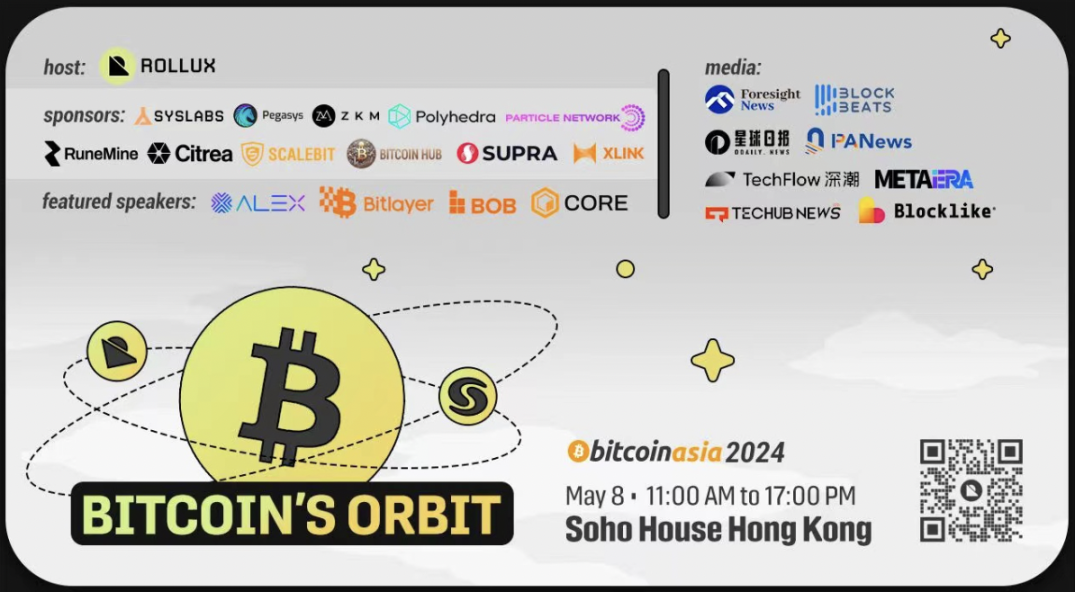
At the same time, Rollux will also host the "BITCOIN'S ORBIT" event at the Bitcoin Asia 2024 Hong Kong Bitcoin Summit, inviting a group of leading players such as Alex, Bitlayer, BOB, and Core to discuss the long-term trends of the Bitcoin ecosystem narrative.
In this vision, Rollux is expected to bridge the liquidity gap between BTC L2 and other multi-chain ecosystems, making Rollux not only the most secure L2 supporting Bitcoin assets but also an intelligent router connecting multiple L2 ecosystems of Bitcoin:
Assets on other Bitcoin L2s can be quickly cross-chained to Rollux, enabling diverse application scenarios; Bitcoin network and Rollux on-chain assets can also be quickly cross-chained to any Bitcoin smart contract chain and use its rich DApp ecosystem.
All that has passed is but a prologue. The BRC20 wave of 2023 can be seen as a preview of the eruption of the Bitcoin on-chain ecosystem, and whether successful or not, with the subsequent changes in the overall fee rate model of Bitcoin, the variables on this path are bound to profoundly change the face of the Bitcoin ecosystem.
The direction in which the dormant trillion-dollar assets will move next is still unknown.
免责声明:本文章仅代表作者个人观点,不代表本平台的立场和观点。本文章仅供信息分享,不构成对任何人的任何投资建议。用户与作者之间的任何争议,与本平台无关。如网页中刊载的文章或图片涉及侵权,请提供相关的权利证明和身份证明发送邮件到support@aicoin.com,本平台相关工作人员将会进行核查。